Thursday, July 09, 2009

Gina Birch at Barden's Boudoir

Gina Birch on-stage at Barden's Boudoir; photo by Val Phoenix8 July
Barden's Boudoir

Dalston truly is a lure for west London's punk pioneers, as following on from last month's visit by Viv Albertine, Gina Birch popped in for a gig.

After sets by Helen McCookerybook and Brooklyn weird-rock duo Christy and Emily (how do two people make so much noise??), Birch took to the stage, guitar in hand, backed up by tapes and projections from her decades of films. She has been working on new material since The Hangovers but it's not clear when this will see the light of day.

The set ranged from Raincoats ("Don't Be Mean") to Hangovers ("I'm Glad I'm Me Today") to quite a few I didn't recognise, but were quite intriguing. Bitterness, regret and quite a lot of anger shine through in Birch's delivery, and her slightly unhinged persona is brewing up nicely.

Thursday, July 02, 2009

Florence and the Machine

A new album, support set for Blur and a storming set at Glasto (how the heck did she get up the lighting rig in those heels?!). It's all go for Florence and the Machine.

Lungs, the album, is currently streaming for two days ahead of its release on the 6th. And it's quite impressive.

I never liked "Kiss with a Fist". Too open to misinterpretation, even if, musically, it's the rockiest thing in her set. But, "The Dog Days Are Over" is one of my favourite songs of the last few years, a wistful, melancholic, start-stop song with cryptic lyrics. And this woman likes her handclaps. It's definitely time for a handclap revival. Other standouts are "The Girl with One Eye" and "Howl", both of which reference tearing out hearts. So, she has a thing for internal organs.

Part flower child, part goth, with nods to Kate Bush and Stevie Nicks, Florence has an oddball, kooky, slightly hippyish retro style that is intriguing, even if it screams pretentious art student. And, indeed she attended Camberwell. One to watch.

Wednesday, July 01, 2009

SO36 Benefit

A landmark of Berlin, SO36 has been called Berlin's CBGBs. The Roxy in London is another comparison, as all three played host to an explosion of counter-culture in the 1970s. But, unlike the latter two, which have disappeared, SO36 is still running, putting on gigs, club nights, and, eh, flea markets and serving as a real community resource, supporting the queer and feminist scenes, among others.

This excerpt from Berlin Super 80 gives a flavour of its heyday.


Having just celebrated its 30th anniversary, SO36 now faces closure because of noise complaints. I wondered if this was another example of the creeping gentrification engulfing the scruffier parts of the city. In response to my query, Henning, who works there, emailed me to say gentrification is a concern but this seems to be an isolated case of one neighbour complaining.

It would be a terrible shame were the SO36 to succumb. Mona Mur, who is playing on a benefit bill tomorrow, recalls many a big night: "I saw some really crucial concerts there, like DAF in 1981 when Gabi Delgado transformed the place into a madhouse. These are indeed memories... As a young punk/wave musician from "westGermany" West-Berlin was the fulfilment of desire. And the SO36 (named after the old postal code of Kreuzberg SüdOst = South East) was the Temple. It is still a cool place although it has seen its Golden Days, I guess."

Berlin Supports SO36 is on 2 July at the Modulorhaus.

Sunday, June 28, 2009

Glastonbury

I've quite enjoyed the Glastonbury coverage on BBC 6Music this weekend, not least when I was contentedly baking a lovely moist chocolate cake while hailstones were smacking against my kitchen window.

6Music has really gone to town this year, with wall-to-wall coverage. Not sure why it's so prevalent this year, but even 5Live's gotten into the act, with a series of links to Worthy Farm interrupting its Wimbledon coverage. Very odd to hear sports reporters attempting to do live two-ways with music journalists, with amusing results.
The Green Fields

But, what was going on with Gabby Logan this morning? I can only think her show was re-routed to Glastonbury because it was Wimbledon's day off. Her interview with Dizzee Rascal was truly embarrassing, with her pressing him on how "young people" feel about politics and him batting away the questions with irritation. "I'd rather chew glass" was his reply to her enquiry as to how he was finding the interview. Stick to News vs Sport, Gabby!

Saturday, June 20, 2009

POUT

Pride London has always lacked a cultural element. (At various times it's even lacked the name Pride, a settled date or any kind of queer identity, but, hey, the '90s was a strange decade, wasn't it?)

Whereas, say, San Francisco's queer film festival handily runs right up to its pride march, London makes do with lots of overpriced club nights for what should be the highlight of the queer calendar. This year, however, POUT's screenings, running from 28 June to 6 July, aim to establish this missing link.

Among the films are two wonderful docs, The Times of Harvey Milk and Before Stonewall, which give a marvellous (if entirely US-focussed) overview of the origins of LGBTQ (and how many letters will be added to that billing in years to come?) activism. I heartily look forward to The Queer Years in the next decade or so.

Or maybe it's already here. Born in '68, a French film spanning 40 years or so of French Left history, although fiction, does a pretty good job of shoehorning in all the relevant touchstones of that country's recent history, running from de Gaulle to Chirac, as well as working in a precis of queer activism of the early '90s. I was struck by how similar the AIDS protests were to those held in San Francisco. And even the T-shirts were the same! This film is also screening at Frameline.

The World Ten Times OverThe POUT schedule features two films programmed by Club des Femmes: The Killing of Sister George and The World Ten Times Over. Two 1960s films directed by men may be strange choices for such an event, but, as Club des Femmes' Selina Robertson explained: "We look for the alternative, we look for politics and dialogue and experimentation... This season, visiting 1960's mainstream filmmaking is a new departure for us, predominantly because for the first time we are screening work by men. But on this occasion we wanted to go back into our history and have a look at some key films from that iconic 60's decade. So we chose two films shot in London that attempted to represent contemporary lesbian lives."

Well, I have had a look at The World Ten Times Over, and I must say it's not exactly brimming with feel-good swinging London-ness. Or feel good lesbian-ness. Two rather unhappy dancehall hostesses sharing a flat have to cope with the disapproving men in their lives as well as an unwanted pregnancy, a suicide attempt and many interesting costume changes. Are they lesbians? Well, it's a kind of blink-and-you-miss-it, coded lesbianism, very well camouflaged by their constant discussions about their boyfriends and male dates.

The London pictured here is a polarised city of executive suites and open-top cars contrasted with seedy after-hours clubs and back streets shot furtively with hand-held cameras. Quite striking but very much a period piece, with a standout performance by Sylvia Syms and an irritating one by June Ritchie as her "friend".

Robertson's take on the selection differs: "We feel that it's very important to remember where we have come from, in terms of our own British lesbian cinema culture. The two films that we have choosen to screen were made pre- and post de-criminalization. One is extremely well known and the other virtually unknown to a wider audience, so we thought it would be a good idea to have a look at these films again in a more contemporary context."

As part of the screening of Sister George, Club des Femmes is seeking reminiscences of The Gateways Club: "We want your memories! If you enjoyed the delights of the Gateways Club will you send us your memories? Who broke your heart? Who lit your cigarette? Is it time to tell all?" Tattletale should be sent to: femmes@clubdesfemmes. Should be enlightening.

Friday, June 12, 2009

Viv Albertine at Cafe Oto

Viv Albertine at Cafe Oto; photo by Val PhoenixCafe Oto
10 June

Ah, sunny Dalston. How well I remember it from days of yore: squatting in a house with no heating, collecting wood from the skip next door, boarding up smashed windows...

So, no Tube strike or distraction of international football could keep me from returning to my spiritual home for a gig by former Slits guitarist Viv Albertine. Out of the public eye for a number of years, she only returned last year for a measly two gigs with the re-formed (but hardly reformed) Slits before deciding life as part of Ari Up's backing band was not for her.

Happily, the experience did get her playing her trusty Telecaster and writing some new sweet-sour pop songs. Yes, pop. No snarling punk rawkness was on show here. Just Viv, guitar in hand, keyboardist (and author) Zoë Street Howe and pianist Steve Beresford. The set was short, sweet and, save a nasty smack in the mouth on her mic, without undue incident. In the house were old muckers The Raincoats and Tessa Pollitt, as well as other "I-was-there-in-'77" stalwarts mixed in with the jazzheads who'd come to see the other acts on the bill.

Love und Romance still seem to be preoccupations for Albertine, as she declared, "This is really depressing. I don't believe in love anymore" while introducing "Don't Believe/In Love". Other titles included "The False Heart" and "If Love", which worms into the brain with its "la-la-la-la" refrain.

There was a bratty, nursery rhyme quality to the lyrics which sat happily with her rhythmic strumming style. Perhaps a bit sedate for the old guard but everyone has to grow up.

Thursday, May 28, 2009

The Story of London

View of River Thames from South Bank; photo by Val PhoenixBoris Johnson, London's mayor (why do I involuntarily shudder when I type these words? It's been over a year!), is something of a gift to comedy writers, a blond-mopped, gaffe-prone Tory with an, uh, colourful personal life.

When he's not almost being run down by an errant lorry while "on a fact-finding mission", Mayor Boris turns his hand to other things, such as improving the cultural lives of all and sundry.

In an effort to persuade Londoners that we live in "the world's most dynamic city", the mayor is laying on The Story of London, a multi-strand jamboree celebrating The Big Smoke, "past, present and future". And there is some good stuff to be found. Not that I ever doubt London has a lot to offer. It's just that civic events tend to be a case of too many cooks spoiling the broth and instead producing a rather tasteless gruel.

Not so The Story of London, which runs for the full 30 days of June. Each weekend has a different theme, the first on 6 and 7 June being Walking Weekend, with a series of walks conducted by Blue Badge Tourist Guides in what is optimistically described as "the June sunshine". We can only hope. I was quite intrigued by "The Corridor of Power" walk, which is only in Polish. Others are in Russian and Japanese.

Most of the walks have fees but a few are free and there are other free events throughout the month, including music, films and exhibits.

Friday, May 15, 2009

Ruby Tuesday Rock Camp

Following on from the plethora of Girls Rock Camps in the USA in the last few years is the first German edition, Ruby Tuesday Rock Camp, to be held in Cottbus in eastern Germany in August.

Registration is now open until 30 May for girls aged 12-16 who would like to try out instruments, learn to scream and enjoy the company of other girls from their peer group.

I know when I was that age, I never had a chance to touch an electronic instrument or make noise. As I recall, when I expressed an interest as an 11-year-old in learning trumpet or trombone, I was told by the music teacher that those instruments were "too hard" for girls to learn and I should stick with the more gentle flute and clarinet. I never did pick up a brass instrument and I was 29 before I tried bass or keyboards.

I attended two Ruby Tuesday events when I was in Berlin, including a gig which is featured in this promo film.


Organiser Jule discussed with me the importance of girls getting a chance to play in bands, as the 12 to 16 age group is just the time when self esteem drops, body issues come to the fore and girls' development seems to shrink. She only started playing drums at 28 and doesn't see why girls should wait until that ripe old age (ahem). "I want them to know they are strong and there is a world waiting for them."

Of course, if any bands come from it, that would be great, but the main message is for girls to express themselves in a supportive environment.

Saturday, May 02, 2009

ATP: Young Marble Giants

Young Marble Giants soundcheck at HAU2, Berlin; photo by Val PhoenixNext week Young Marble Giants will take the stage at All Tomorrow's Parties in Minehead. Knowing the Great British Weather, it will probably rain. But, that's OK. YMG are probably more suited to a rainy day than a sun-kissed summer festival.

When I saw the re-formed band earlier this year in Berlin, they received a rapturous reception, running through most of the songs on their 1980 debut, Colossal Youth, and then, for their encores, re-playing the ones they'd messed up earlier. Few bands could get away with that, but they have such laid-back charm and such good will from having been away so long, that it worked. And the encored songs were better the second time around.

These days YMG don't get out much, their appearances limited to the odd invite. For their gig at ATP, they will perform Colossal Youth in its entirety, as part of the fan-curated programme.

ATP will mark the first time the whole record has been played live, as the Berlin set list left off a few songs that guitarist Stuart Moxham still needed to re-learn. The product of youth, insecurity and vivid imagination, the record still astonishes after 29 years, full of open space that allows the songs to breathe. Melancholia ages better than anger, and the record is full of wist and longing.

As a young band, they weren't so keen on performing live, being wracked with insecurity. Bassist Philip Moxham confessed to staring at the wall during gigs, while singer Alison Statton said she lacked confidence in life, let alone music.
Backstage before the Berlin gig, I asked them about their reunion and playing live.

KB: Why are you back?
Stuart Moxham: For the money.
Alison laughs.

So, it's a big post-punk minimalist sell-out?
Laughter.

SM: We originally thought it would be a good idea to try and do another album. We said whatever we do, we won't come back and be an '80s comeback band. But, as it happens, that is what we're doing.

Philip Moxham: It's largely, as well, because of the unprecedented enthusiasm for the record. People who have been listening to it for the last 30 years or so have said they are quite pleased to see us playing. Plus, there are a lot of younger people who are into the band.

Are there particular challenges to playing live?
SM: There are for me, because all the keyboard stuff is kind of difficult to work out. "What is that chord?" And the same with the guitar, because since this group I haven't played electric guitar, really. That's a long time ago.

How do you feel now performing the songs? Does it mean something different?
Alison Statton: It definitely means something different. In one sense it feels as if we never stopped playing and we're just a few months on, but in another way we're much more relaxed about it all. Just appreciating the music for what it is more, because we've had that time and that separation.

Young Marble Giants perform Colossal Youth at All Tomorrow's Parties, Butlin's, Minehead, Somerset, on 9 May.

Saturday, April 18, 2009

Exterra XX

Verena Kyselka shows some of her artwork; photo by Val Phoenix
Featuring alongside the arrival of the re.act.feminism video archive this week at the Kunsthaus Erfurt is a retrospective of the women's performance group Exterra XX. Starting out as the Frauengruppe and then the Kunsterlingruppe and conducting its activities covertly while under Stasi surveillance under the old DDR regime, the group blossomed into Exterra XX and existed until 1994, when it disbanded.

Before that, however, the members put on "fashion object shows" and performances, made Super 8 films and founded the Kunsthaus Erfurt, which is returning the favour by staging this 25-year retrospective.

While attending re.act.feminism earlier this year in Berlin, I met two former members of Exterra XX, Verena Kyselka and Gabriele Stötzer. Both had been under Stasi surveillance and were considered enemies of the state. Nevertheless, they doggedly pursued their artistic ambitions, as well as sticking to their beliefs, which under the stifling conditions, is quite admirable. Amazingly, none of the women in the group informed on the others, though some of their own nearest and dearest, including Kyselka's partner at the time, did.

This became clear in the early 1990s, with the release of the files the Stasi held on anyone considered worth observing, which numbered millions. Both Stötzer and Kyselka have incorporated their Stasi files into their artwork (see pic for Kyselka with an image of a project in Erfurt). And in October Stötzer will be staging a recreation of a momentous event--the storming of the Erfurt Stasi offices in 1989.

It's an emotive topic. After we spoke at the conference, I emailed Stötzer for further comment and she sent her replies in German. I've been wanting to make this blog bilingual anyway, so here is some of our exchange, in which she discusses the re-staging and the difficulties of working in groups.

(KB) Could you say what you and the other four women did in invading the Stasi office? When was this? Was it planned? Was it a political act or a form of performance? What would you like to do with this performance you are planning in October?

(GS) die erste stasistürmung war in erfurt. es war am 4. dezember 1989... es war nicht geplant, die frauen sagen: es war notwendig und wir haben es gemacht. nach unserem anfangen und der erfahrung das die stasi nicht schiesst haben die anderen städte schnell die anderen stasizentralen eingenommen und dadurch viele akten vor der vernichtung gerettet.... ich will einerseits das durch die wiederholung der stasistürmung mit den authentischen personen dieses geschichtsbewußtsein wieder mit der wahrheit getränkt wird und das die frauen die damals spontan und politisch verantwortlich reagiert haben (und ihr leben aufs spiel setzten) diesmal ihr persönliches vermächtnis mit in die aktion bringen. damals mußten wir nur in den vorgefundenen verhältnissen reagieren, jetzt können wir unsere eigene persönliche vision mit in das geschehen geben. noch einmal klar: damals das war eine politische aktion, diesmal wird es kunst werden.

I was interested when you said that the women were all united until after the Wende. And that it's necessary to go your own way. What did you mean? And how do you feel about the reunited state and your place in it?

die frauengruppe war in der ddr eine form uns selber gegen das herrschende system, das anpassung verlangte, als individuum auszusprechen. dazu kam das innerhalb dieser gruppe jede einzelne sich über ihre eigenen grenzen hinaus entwickeln konnte und durch die gruppe geschützt war. wenn sich z.b. bei einer performance eine frau ausgezogen hat, wurde sie durch das normale umgehen der anderen frauen in der gruppe gestärkt. auch die angst vor den represalien wurde als gruppe gemeinsam besser ertragen. als dann die wende kam und wir ein kunsthaus gründeten, wurde nicht weiter nach frauenbildern oder unserer eigenen gruppendynamik geforscht. das haus existiert, weil es von außen finanziert wird und wir auf die anforderungen der finanzierer (stadt, ministerium) reagierten. ich bin weggegangen weil ich weiter allein für mich aus mir heraus schreiben wollte und nicht lesungen anderer in dem haus organisieren. nach der wende war der zusammenhalt gegen das system nicht mehr da. jede konnte sich allein retten und mußte es auch lernen. ich hatte bis dahin die leitung übernommen und habe mich selber abgesetzt, bzw. bin selber abgesetzt worden.

The re.act.feminism video archive and Exterra XX retrospective are showing at the Kunsthaus Erfurt from 21 April to 10 May. Gabriele Stötzer peforms on 19 April.

Thursday, April 09, 2009

LLGFF: Tru Loved

Still from Lion's Den
Tru Loved, dir Stewart Wade
Lion's Den, dir Pablo Trapero
To Faro, dir Nanna Neul

Three tales of forbidden love and social barriers.

US high schools are a fertile ground for films in a way other educational systems don't seem to be. There's something about the social pressures, hierarchies and cliques that is irresistible to filmmakers. Tru Loved is the latest such comedy, dropping a coming out story into this social pressure cooker.

The title character is the new girl at school, moving from San Francisco to the boondocks at the behest of her two moms. Ignored by the self-appointed cool kids, she is thrilled when quarterback Lo asks her out. Envisioning romance around every corner (the film makes great use of fantasy sequences), Tru is brought down to earth when it becomes clear that Lo is a closet case. Undaunted, she sets out to establish a Gay-Straight Alliance (these have become omnipresent in the last decade but certainly didn't exist when I was at school) at her school and finds herself confronted by all manner of complications, while maintaining her "romance" with Lo. Funny and well-written, the film has a few flat moments but has some real bite and intelligence, not the least in its use of "Katie" as a term for a beard. How did that get past the lawyers?

Not nearly so upbeat is the Argentinean prison drama Lion's Den, featuring a standout performance by Martina Gusman as Julia, imprisoned for the murder of her boyfriend and the attempted murder of their mutual lover. Thrown into prison and giving birth there, Julia must raise her son Tomas within the walls while fighting her conviction. Refreshingly unsensationalistic in its treatment of prison and the love affair that Julia begins with fellow inmate Marta, the film is sensitively directed by Pablo Trapero and asks a difficult question: is it better for a child to be raised in prison or taken away from his mother at age four?

Asking, but not answering, questions about perception is To Faro, a German film about mistaken identity that is an uneasy mix of comedy and drama. Stifling in her job at a company providing airline meals, Melanie jumps at the chance of dating cute teen Jenny, even if it means adopting the identity of Miguel, a Portuguese emigre. Conducting a romance under false pretences leads to comical mix-ups and very serious consequences, with abrupt shifts of tone that are jarring. As Melanie leaves home, the film offers her an escape from her predicament but not the underlying problems.

Reblog this post [with Zemanta]

Tuesday, April 07, 2009

LLGFF: DIY

Still from Bandaged
Travel Queeries, dir Elliat Graney-Saucke
The Lollipop Generation, dir GB Jones
Bandaged, dir Maria Beatty

A couple of films that put the Q in LGBT, so to speak, Travel Queeries and Lollipop are both long in the making, a reminder of how hard it is to make DIY films that go under the radar of funders. Travel Queeries documents queer subcultures across Europe, from London to Belgrade and features an array of inspiring real-life characters who work under the most arduous conditions, from the activists who brave violent attacks in Belgrade and Warsaw, to the artists who liven up their surroundings in Copenhagen. The film also points out how these cultures are being united, with the Internet and travelling activists serving to link disparate cultures, a function the film serves, as well.

GB Jones is a legend in Toronto, co-founder of the original homocore zine JDs and the dyke band Fifth Column. Her magnum opus The Lollipop Generation was started in the early 90s and has only just reached completion, so feels a bit piecemeal, with star Jena von Brucker's hair colour changing from scene to scene. Surely a continuity editor's nightmare. I don't mind the DIY roughness of the film and positively revel in the grainy Super 8 quality, which suits the story of a teenaged runaway (von Brucker) and her adventures with the street kids she meets.

My reservations lie more with the storyline, with von Brucker reduced to a mere linking device, as the story shifts to street teens Peanut, Janie and Rufus, who are pursued by the "Horrible Homos", porn makers with a taste for kids. The appearance of Vaginal Davis, whose character picks up a boy outside a school, flings him over his shoulder and then attempts to have sex with him, is just plain creepy. Davis has great comic appeal and the scene appears to be played for laughs, but what is the message? That paedophilia is funny? That the situation, in which the only black character in the film is a sexual predator, is meant to be a comment on social stereotypes and so should be read ironically? Jones seems to revel in sexually explicit scenes, with a plethora of blow jobs, at the same time she seems to be decrying sexual exploitation of street kids. The message seems hopelessly muddled and so undermines the film.

While Bandaged is coming from a completely different place, it stars Susanne Sachsse, who has featured in several Bruce La Bruce films, as well as leading Berlin's Cheap arts troupe, which numbers Vaginal Davis among its members. I had high expectations for this film, which was billed as a horror period piece. The set-up is intriguing, as Sachsse's Nurse Genova arrives at a remote mansion to tend to the wounds of Lucille, a suicidal teen, at the behest of the girl's domineering scientist father.

Nurse Genova has a questionable record, with a penchant for putting patients out of their misery which is not in line with the Hippocratic oath. She becomes attached to the girl, with much face-stroking and suggestive washing. But what are her motives? And where is dad getting his amazing skin grifts from? Yes, these are the dual plot lines and they play as ridiculously as they sound. The dialogue is so stilted, it sounds dubbed, badly. The best shots are reserved for syringes, and Sachsse is called upon to act in some of the worst sex scenes committed to film. So bad, it's good.

Reblog this post [with Zemanta]

Monday, April 06, 2009

LLGFF: Ulrike Ottinger

Still from Madame X - an Absolute RulerThe festival capped off its mini-retrospective of Ulrike Ottinger with the premiere of Prater, her documentary on Vienna's famed amusement park, not her queerest work but one that encompasses many of her themes, both in terms of content and form: the sharp observation, playfulness, and fascination with exoticism, among others.

I found the film beautiful and also bewildering in parts, which may sum up my response to Ottinger's work as a whole. Her imagination sometimes leaves the viewer behind. Prater is in some ways the most straightforward of films, a documentary looking at an amusement park that serves as both pointer to the future and past, one which has pushed technology throughout its history but is also supremely kitsch, offering the comfort of nostalgia.

Ottinger, of course, has deeper concerns and her selection of attractions, including dancing monkey figures and rictus-grinning magicians, is telling. Within the long film are many stand-alone scenes, including one she described in the panel discussion as a "short film on machismo", an extraordinary sequence in which a group of young men unleashes a torrent of violence in pursuit of pleasure, egging each other on to ridiculous heights as they compete in a game.

The festival showed three of Ottinger's earlier works, Madame X - an Absolute Ruler, Johanna d'arc of Mongolia and The Image of Dorian Gray in the Yellow Press, illustrating her views on gender, sexuality and power relations.

Madame X, I was surprised to learn, was quite controversial on its release in 1977, with some feminists expressing outrage at its depiction of a group of women offering themselves in servility to the "absolute ruler", Madame X. Seeing it for the first time, I actually found the film quite mild and, indeed, chaste in its depiction of lesbian sexuality. But the suggestion of S/M was considered outrageous at the time, as was Bildnis einer Trinkerin, for its depiction of the sexual underworld of Berlin in 1979. A pity this latter wasn't up for re-consideration on its 30th anniversary.

Thursday, April 02, 2009

Rewind

Back in the day, when I lived in San Francisco's Castro District, periodically there would come a knock on the door and I would answer it to find the slouching figure of Lynn Breedlove standing there, holding a package requiring my signature. Knowing her to be the singer in Tribe 8, as well as in the courier biz, I would ask what her band was up to, and she would hand me a flyer, usually for a gig at El Rio (tagline: Your Dive) or some other sweaty local venue. Ah, those were the days.

So, it was with a touch of nostalgia that I found myself a couple of nights ago watching the new, improved, transified Lynnee Breedlove, not hollering shirtless into a mic or chopping up a dildo but striding onstage nude, save a harness and purple appendage, at Bar Wotever. Not content with being a musician, novelist, and filmmaker, Breedlove is now trying out stand-up comedy. It wasn't the most side-splitting set, but there were a few good one-liners and, with charisma to burn, Breedlove carries a great deal of charm, even if the material was a bit, eh, d__k-heavy for me.

The evening was a bit of an SF-early 90s reunion, as not only did I see a few familiar faces from the past at the gig, but earlier I was reunited with an old activist pal-turned-filmmaker, Consuelo Ramirez, whose doc on Yo Majesty, Keep It Movin', showed at the LLGFF. This being her first film, she was thrilled to come to London to show it and had a plethora of behind-the-scenes stories about the band, which I can't repeat but which may turn up in her book in progress.

I tell you it was almost like 1991 all over again, but that's silly. After all, back then there was a recession and the USA was engaged in a pointless war in the Gulf.

Wednesday, April 01, 2009

LLGFF: Society + The New World

Still from The New World
The New World dir Etienne Dhaene
Society dir Vincent Moloi

Stop the baby madness! In French comedy The New World, Lucie and Marion decide their domestic bliss can only be completed with the addition of a sprog. Hence, their search for the perfect donor, with castings, a phone-round by their female friends and the eventual choice of Marion's pal Hugo, conveniently based on the other side of the world and so unlikely to interfere. Or so they think.... Well-acted, written and directed, the film also has a serious point in that non-straights in France can neither adopt nor use alternative insemination and so usually end up going to Belgium to conceive.

Society
is an entirely gloomier, yet equally sparkling, affair, as a group of black women in South Africa is reunited by the death of a former school friend. Will the closeted teacher come out to her pals? How will the reluctant mother cope with a child? And will the two former rivals ever get along? With equal parts drama and knockabout comedy and entirely focused on female relationships, it's what Sex and the City should have been.

Tuesday, March 31, 2009

LLGFF: Love in Suburbia

Still from I Can't Think Straight
Patrik 1,5 dir Ella Lemhagen
I Can't Think Straight dir Shamim Sarif

Family life is a big theme this year at the festival and these two rom-coms explore different facets. In the Swedish comedy Patrik 1,5, Goran and Sven's plan to adopt a sweet baby take a wrong turn as they end up with 15-year-old homophobic tearaway Patrik. A sharply observed satire of what lurks behind the manicured gardens and Volvos in the driveway of suburbia is the main attraction of this film, along with Goran, Sven and Patrik's interplay. Very well done.

The polo fields and palatial residences of I Can't Think Straight don't belong to any London I recognise, but this comedy operates in a pseudo-Richard Curtis world in which everyone is rich and looks like a model. Instead of a floppy-haired Hugh Grant, we get glacial Lisa Ray and wide-eyed Sheetal Sheth negotiating a bumpy cross-cultural romance, observed by their traditional families. These two were the leads in Sarif's The World Unseen (shot after this film but released before), which was also beset by clunky dialogue and over-acting. In this film, I found Ray quite wooden and not believable as a Jordanian, her emotional range veering between flirtatious and slightly puzzled. Many of the supporting characters, such as Nina Wadia's maid and the two mothers, are reduced to one-note jokes. A pity, as the film looks sumptuous and there are some fine comic set pieces.

Sunday, March 29, 2009

23rd London Lesbian and Gay Film Festival: an organic otherness

The Raincoats
A quick recap of the first few days of the festival, which I've only been able to attend sporadically so far.

Opening night on Wednesday featured Karin Babinska's debut Pusinky (Dolls), a road-buddy-teen melodrama of three Czech teenaged girls' disintegrating relationships as they hitch-hike to the promised land of Holland for some summer work. Betrayal, sexual awakening, rivalries, suicide attempts. I felt I'd seen it all before. Indeed, the set-up and events reminded me very much of two films I've viewed in the last six months: the Russian drama Everybody Dies but Me and the German film Beautiful Bitch.

As such, the film felt like a throwback to the bad old days when coming out as a lesbian was treated with a lot of hysterical hand-wringing. And why is it de rigueur in every coming-of-age drama for female friendships to be cast aside? A strange choice for an opening night film. On the plus side, I did snaffle several free chocolate bars laid out between the seats.

Last night I attended the much-anticipated premiere of the Raincoats doc, with added Q and A and live performance. Quite an ambitious undertaking and largely successful, with one big proviso.

Directed by bassist Gina Birch, the Raincoats film (still not sure of the title) combines brilliant archival material from the band's beginnings in the throes of '70s punk with interviews with band members and admirers including Geoff Travis, Chicks on Speed, Peaches and David Thomas of Pere Ubu. The latter's comments, delivered through shut eyes, were amusing, even if he did appear to suggest that they had no memorable songs. He also said something about "an organic otherness" that rang true in unexpected ways.

Among those in the audience were interviewees Viv Albertine of The Slits, just now getting some new material out, and Jane Woodgate of The Mo-Dettes, now establishing herself as a sculptor. Where have all you original punk women been, I asked Viv. "I don't know", she said, before adding that now seems a good time to get back in, as it reminded her of the punk times.

There was so much love in the room. And when a four-piece version of the Raincoats took to the stage, it was to a very supportive hometown crowd. Every cocked up note and false start was greeted with an appreciative cheer. "You are getting the full Raincoats experience" cracked Gina.

Still, I left troubled. You see, while it was delightful to see this band get its due, VERY, VERY late in the day, and while I enjoyed the atmosphere and the gig rocked, what stayed with me was what wasn't said: where was the queer content? Why, at a lesbian and gay film festival, with a panel of mostly lesbians, was there no mention of the L word? Why does this still happen in 2009? I left feeling as if we really had returned to the dark ages, when these things just weren't spoken about and lesbians were invisible. Like the film, a work in progress.

Reblog this post [with Zemanta]

Saturday, March 14, 2009

After the War, Before the Wall

Still from Fanfaren der LiebeAs the 20th anniversary of the fall of the Berlin Wall approaches this autumn, much cultural introspection is taking place. The Berlinale recently showed a strand of films which presaged the fall of the wall, while the TV and Film Museum in Berlin will be exhibiting photos and films from 1989.

Now the Goethe Institut in London is running a film season looking at an underanalysed period before the New German Cinema. Running from March through June, After the War, Before the Wall is a selection of 20 films from West Germany which offers a real insight into that difficult time as Germany confronted the war and its aftermath. Giving something of an insight into fluctuating identity, the films are variously attributed to Germany (West), Germany (East), FRG, BRD and Germany.

Running pretty much chronologically from 1946 to 1960, the genres include social satire, war drama and romantic comedy. Opening the programme on 17 March, Die Mörder sind unter uns [The Murderers Are Among Us] (1946, dir. Wolfgang Staudte) is the only East German entry (and it would be marvellous to contrast the East and West German output from this period) and features Hildegard Knef's first screen appearance, as a doctor plots revenge on a war criminal in 1945 Berlin.

Subsequent screenings include a couple by expats who returned to the homeland to make films: Peter Lorre's only directorial effort Der Verlorene [The Lost One], from 1951, as well as cinematic titan Fritz Lang's Die tausend Augen des Dr. Mabuse [The 1000 Eyes of Dr. Mabuse] from 1960.

Social dramas are prevalent in the programme. In jenen Tagen [In those days] (1947, dir. Helmut Käutner), which uses a car and its owners to tell the turbulent history of the previous twelve years. The mixed race title character of Toxi (1952, dir. Robert A. Stemmle), confronts prejudices that existed against the children of German women and black American GIs.

Here's a familiar-sounding plot: two jobless male musicians go undercover in a women's band. Originally a French film, Fanfaren der Liebe [Fanfares of Love] (1951, dir. Kurt Hoffmann) [see pic] was re-made by Billy Wilder as Some Like It Hot.

And, finally, a tale of cross-border forbidden love flourishing among ruins. Himmel ohne Sterne [Sky Without Stars] (1955, dir. Helmut Käutner) is set in the no-man's land between east and west.

After the War, Before the Wall runs 17 March to 30 June at the Goethe Institut, London.

Reblog this post [with Zemanta]

Saturday, March 07, 2009

Around the World in 60 Days with Gudrun Gut

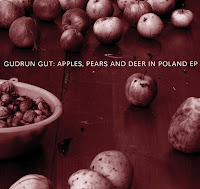
Cover of Gudrun Gut EP
Right about now Gudrun Gut should be on her long journey home after a two-week Antipodean trip, with a festival appearances and other gigs. Before she touches down in Berlin, though, the Monika boss has a stopover in Beijing where she plays on the 8th, International Women's Day. Later in the spring, it's off to the USA. So, busy, busy.

And indeed, she was so busy that it was difficult to link up for an interview while I was in Berlin earlier this year. However, before she set off last month, we spoke briefly about her plans over the next few months and about the new EP, her first foray into download-only releases.

Coming up on 19 March is the premiere of her collaboration with sound artist AGF, which will air on Late Junction on BBC Radio 3 in the UK. The theme sprang from a shared interest of the two, as she explained. "It's called Baustelle, it's about a building site, because she built a house and I built a house. But she built a house in Finland and so she doesn't live here anymore. We developed four new pieces for this. And we really enjoyed that, actually, and so we're gonna do more. We want to do an album out of that and that we wanna have finished for autumn, actually. We already have 20 minutes, so it's not so much. We want to do some live shows together."

Gudrun's house is the country house she is building in Brandenburg, north of Berlin. It is one aspect of her new-found interest in nature, which extends to artwork she contributed to the Transgression exhibit as well as her new EP, whose title is almost as long as the four songs within: Apples, Pears & Deer In Poland touches on romanticism and nature.

I can't remember discussing fruit in an interview but Gudrun was quite enthused by her rediscovery of "these sorta like really old German normal fruits", as opposed to the foreign imports that dominate the market. "But going back and eating a good German apple and a good German pear is something really exciting, I thought. Especially if it's not treated and stuff, it tastes beautiful and it looks beautiful. And I thought that it's so different if you have it in the shop or if you just have it from the tree. They just look much more beautiful when they are not so polished."

Another track on the EP, "Harz4Schleife", finds her taking a walk through nature and balancing her response to the beauty of the surroundings with the reality of the inhabitants. "You know, in Germany we have a problem: Landflucht. People from the countryside all move to the city, so, especially around Berlin, there are like only some men. Most women left, because they're, you know, a little bit more clever (giggle) and a couple of men are still there but they're mostly unemployed, so it's really strange because it's a whole different life there, around the country. It's because all the people who are a bit clever left."

She continued, "But then, on the other hand, it has a real life quality because it's not so full as the city. It's not Beton [concrete]. It's not so much houses. It's just like real nature. So, it's like all kind of soft earth you walk on. This has a real fascination. I'm really fascinated with this. Because, you know, I'm like much more like a culture girl. I like computer games and stuff, so this virtual world always was more my world and then I discovered that this new thing (chuckles) for me was nature. It's interesting. I find it really interesting, because there's like some depths I never expected."

Foresaking the lure of native fruit, she is heading in April to Colorado for an appearance at the Communikey festival and a week-long residency at the Uni of Colorado Boulder campus, where Prof. Gut will speak on her life as a self-made artist. This has prompted a bit of digging into the archive to find appropriate photos and so forth. It is now 30 years since she first emerged with experimental bands Din A Testbild and Mania D, and so there is a wealth of potential material, but as of our discussion, she had yet to finalise the speech.

But, how would the one-time scourge of "hippieverseuchten Berlin" cope with the crunchy granola goodness of Boulder? "Oh, no problem. I don't mind hippies at all." A volte face! She laughed. "That was in the '80s." Never mind. Surely, self-made artists are allowed to be contradictory.

Sunday, March 01, 2009

Lost and Found

Lost keys at the BVG lost property office; photo by Val Phoenix
New month, new country, or rather, old country, as I am back in Blighty. Ah, London. Where one experiences three seasons in three days: spring on Thursday, summer on Friday and now, back to winter. Gotta love it.

I returned from Berlin slightly lighter both in personal weight (6kg, thanks to my unintentional Toast diet) and in luggage, as I managed to leave my tiny, tiny rucksack on a tram while doing the WG shopping. Nothing hugely financially valuable but I cursed my own stupidity and the loss of my reporter's notebook. What is a journalist without a notebook? That hurt: two months of my precious notes vanished into the ether.

I didn't give up without a fight, naturally. I was on the phone to the BVG, the transport authority several times. I phoned my mobile (also in the rucksack) and left a hopeful message (actually one of my housemates did) in German and English, asking anyone who found said item to phone the house number.

And on my last day in Berlin, rather than visiting any one of the multitude of attractions I'd missed in the preceding six weeks, I did a tour of Berlin Fundbüros: firstly, the BVG, where I was asked various details I could not supply, such as the model number of the phone. The sight of the umbrellas hanging forlornly from hooks and the notice of an impending AUCTION of unclaimed items was sobering.

Then it was on to the S-bahn Fundstelle, which I found with some difficulty and then stood outside for ages while the one man on duty attended to a call from some other hopeful seeking a bag. Through the open door I could see what looked like a locker room of items, all tagged. When he did speak to me, he showed me two small bags and several phones but none was mine.

Lastly, it was off to the Zentrales Fundbüro, but, horrors, it was closed! I returned to my flat feeling a lack of closure: if only I could have visited the Zentrales Fundbüro....

Back in London my first day, what do I find in my email? "Found in Berlin".... Surely not. I was a bit suspicious. A neighbour of the emailer had found a backpack "somewhere in Berlin". It seemed too vague to be true. But I emailed back with some identifying info and hoped for the best.

And two days ago, a friend of mine in Berlin emailed to say she had collected the rucksack and all the items were intact. Amazingly, an older couple had found the rucksack on the tram, extracted my business card with my email address and asked their neighbour with Net access to email me to make contact. To them, a hearty "Vielen Dank". If I had cockles, they would be well and truly warmed.

My journalistic career is saved, faith in humanity restored, etc. ;)