Showing posts with label pride. Show all posts

Monday, June 21, 2021

Lesbian Period Drama

 As it's Pride month (and has been for 21 days. Oops. Been busy, ya know?) and um, not really very much is allowed to happen IRL I thought I would post this Saturday Night Live sketch from a couple of months ago when Carey Mulligan hosted. I thought it was extremely well produced and many commenters on Twitter said, "I want to see this film!". I would see it, if only because there are so few lesbian films out there, but, yes, it does, eh, touch on a lot of tired tropes which have irritated some film watchers.  

I see that Bristol Pride's Queer Vision film festival is hosting a discussion online on 12 July called Not another Lesbian period drama! which will consider on-screen representation. In the meantime enjoy SNL's pisstake with a guest appearance by actual lezzer Kate McKinnon. Happy Pride!


Monday, June 22, 2015

ACT UP 25 memories

SF Pride 1990; photo: L.A.
While I am a great one for marking anniversaries, I almost let slip a very big one: the 25th anniversary of ACT UP protests at the Sixth International Conference on AIDS. Not that I forgot about the actions. They were my coming of age as an activist. I only joined ACT UP in the weeks leading up to the protests and was a very nervous legal observer at some of the demos during that week in June. But, I decided to put my body on the line, as it were, and join in the Women's Day Action, which was June 22, 1990, 25 years ago today.

I wrote a bit about this time in my recently completed MRes dissertation, which I quote below.

Coming out in 1989 was not about exercising personal freedom, and it certainly was not about donning the cloak of respectability to be like everyone else, join the military or get married. It meant joining a community under siege. Once I came out, I knew I had a responsibility to this community, and I was quick to join direct action groups ACT UP and then Queer Nation, seeking to do my bit. I do not think this Generation Y (or whatever they are called) necessarily has this raison d’être. As Jose Muñoz writes in Disidentifications, “The social is both a stage and a battlefield” (Muñoz 1999, p. 199). Every day we need to pick our battles carefully. And ACT UP exemplified this in its tactics. Many members of ACT UP made it their business to get arrested. One of my comrades, Peggy Sue (she described the moniker as her nom de guerre), was quite keen on it, turning her arrests into a kind of performance art. She had mastered the art of yelling as she was dragged away and was known to enjoy the process, ticking off her arrests with pride.
I was not so keen. As my particular battlefield, I chose a big one, getting arrested at the Sixth International Conference on AIDS in June, 1990. It was the women-only day, and I sat down with several hundred others at the intersection of Sixth and Market streets, thereby “blocking a public thoroughfare”, as the charge sheet described it. My friend L. was meant to stay on the side-lines and hold my glasses, but when I arrived at the jail with scores of other detainees, a police officer drew my attention to someone waving to me from an adjoining paddock, my spectacles in her hand. L. told me later she could not refrain from joining in when she saw us being arrested. My glasses were unharmed, and I was grateful to see clearly once more. During our stay in jail, we held an activist fashion show, women parading down an imaginary catwalk, hands still cuffed behind their backs. Availablism in action.
True to form, San Francisco has been marking the anniversary in fine style, with events at old haunts such as The Women's Building and Cafe Flore. I wish I'd known well in advance. But, I like to think I have joined in the reunion in spirit, if not in person.

Two days after that demo was my first Pride march, which I attended in my Women ACT UP t-shirt, protest turning to celebration, as various marches flowed into one another and we experienced the mix of emotions that comes with the cycle of life and death.

Saturday, June 20, 2009

POUT

Pride London has always lacked a cultural element. (At various times it's even lacked the name Pride, a settled date or any kind of queer identity, but, hey, the '90s was a strange decade, wasn't it?)

Whereas, say, San Francisco's queer film festival handily runs right up to its pride march, London makes do with lots of overpriced club nights for what should be the highlight of the queer calendar. This year, however, POUT's screenings, running from 28 June to 6 July, aim to establish this missing link.

Among the films are two wonderful docs, The Times of Harvey Milk and Before Stonewall, which give a marvellous (if entirely US-focussed) overview of the origins of LGBTQ (and how many letters will be added to that billing in years to come?) activism. I heartily look forward to The Queer Years in the next decade or so.

Or maybe it's already here. Born in '68, a French film spanning 40 years or so of French Left history, although fiction, does a pretty good job of shoehorning in all the relevant touchstones of that country's recent history, running from de Gaulle to Chirac, as well as working in a precis of queer activism of the early '90s. I was struck by how similar the AIDS protests were to those held in San Francisco. And even the T-shirts were the same! This film is also screening at Frameline.
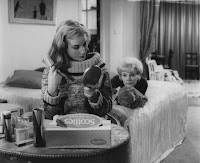
The World Ten Times OverThe POUT schedule features two films programmed by Club des Femmes: The Killing of Sister George and The World Ten Times Over. Two 1960s films directed by men may be strange choices for such an event, but, as Club des Femmes' Selina Robertson explained: "We look for the alternative, we look for politics and dialogue and experimentation... This season, visiting 1960's mainstream filmmaking is a new departure for us, predominantly because for the first time we are screening work by men. But on this occasion we wanted to go back into our history and have a look at some key films from that iconic 60's decade. So we chose two films shot in London that attempted to represent contemporary lesbian lives."

Well, I have had a look at The World Ten Times Over, and I must say it's not exactly brimming with feel-good swinging London-ness. Or feel good lesbian-ness. Two rather unhappy dancehall hostesses sharing a flat have to cope with the disapproving men in their lives as well as an unwanted pregnancy, a suicide attempt and many interesting costume changes. Are they lesbians? Well, it's a kind of blink-and-you-miss-it, coded lesbianism, very well camouflaged by their constant discussions about their boyfriends and male dates.

The London pictured here is a polarised city of executive suites and open-top cars contrasted with seedy after-hours clubs and back streets shot furtively with hand-held cameras. Quite striking but very much a period piece, with a standout performance by Sylvia Syms and an irritating one by June Ritchie as her "friend".

Robertson's take on the selection differs: "We feel that it's very important to remember where we have come from, in terms of our own British lesbian cinema culture. The two films that we have choosen to screen were made pre- and post de-criminalization. One is extremely well known and the other virtually unknown to a wider audience, so we thought it would be a good idea to have a look at these films again in a more contemporary context."

As part of the screening of Sister George, Club des Femmes is seeking reminiscences of The Gateways Club: "We want your memories! If you enjoyed the delights of the Gateways Club will you send us your memories? Who broke your heart? Who lit your cigarette? Is it time to tell all?" Tattletale should be sent to: femmes@clubdesfemmes. Should be enlightening.