So many things I am meant to be doing: clearing space to finally set up proper bedroom instead of sleeping on futon in office, writing speculative article on artist/filmmaker, prepping re-construction of destroyed radio show, oh, and blogging.
I have been asked a few times for end of year/decade lists, but find I have nothing to say in this format. Why is this? I used to love lists. I would never go shopping without one and about a decade ago used to compile all my favourite songs into a bespoke compilation tape for my own enjoyment.
Now, however, I have become listed out by other people's lists. It seems the easiest way to fill space in media outlets and strikes me as, quite frankly, the laziest of lazy journalism. So, I am not doing one. Everyone can make up her or his own mind about favourite and least favourite things. So there.
Sunday, December 20, 2009
Saturday, December 12, 2009
Odd Girl Out
 At this time of year, with the wet and cold persisting, it's a good time to nestle in the welcoming bosom of radio (so to speak), but for me this daily ritual has added piquancy, as for the last two months I've been producing and presenting my own show. Odd Girl Out airs weekly on the web station Optical Radio, and it's been a welcome return for me to the airwaves after a long gap.
 The idea came to me some time in the early '90s when I still lived in San Francisco and was writing a bi-weekly column on women and the arts for a local queer paper. Once I moved to London and began researching what should have been my book on women and underground music (long story), I began to think it would be great if there were a way to bring the music alive, so to speak.
The first version of Odd Girl Out aired way back in 1996, but it's been a long time finding an outlet for uncensored, un-formatted radio that mixes music and speech and allows me to delve into my archive and record collection.
Slowly, I have been digitising old cassette-recorded interviews and extracting short clips to air on the show. So, far the wisdom of Beth Ditto, Elizabeth Fraser, Gudrun Gut, Cornelia Schleime, Verena Kyselka and Melanie and Dolly of Mad Chicks has seen the light of day. And I've had my first live in-studio interview, with photographer Jaine Laine.
It's still a work in progress and I am adding features as I think of them, but it's great to be back on air and get the work of these amazing women out there. My playlists are posted on my journalistic site. Any suggestions, links or MP3s can be sent to valphnx (at) myspace.com.
Thursday, December 03, 2009
Confidence Is a Preference
I was well chuffed to open last Thursday's Guardian, while waiting for my laundry, and see Liz Fraser's visage. "Aha, finally!" I thought, as it's been a long wait for the former Cocteau Twins singer's debut album. I seem to recall she signed to Blanco y Negro in about 1999. So, a long wait, indeed. She doesn't even have a proper website, just a rather threadbare work in progress. But, I am sure whatever Liz comes up with is worth waiting for.
Sadly, the article doesn't give any great hope. Though she left the group of her own volition, having already set up house in Bristol with her partner Damon and given birth, Liz doesn't seem to have found any great peace of mind and her old insecurities seem to have followed her into her new life. Having interviewed her a few times back in the '90s, I found her extremely personable, able to laugh at herself and others and, of course, quite talented and creative. I had great hopes for a solo career, in which she could finally express herself, unhindered by others' expectations. But, at least from her comments in the article, she still seems to find it hard to release anything for public scrutiny, new single aside.
It makes me wonder: what is the point of being in a band, if it doesn't add to your confidence and sense of capability? I have met many women who leave bands and don't seem to take good things away with them, as if they feel they can only create with their bandmates around them. So sad.
Sadly, the article doesn't give any great hope. Though she left the group of her own volition, having already set up house in Bristol with her partner Damon and given birth, Liz doesn't seem to have found any great peace of mind and her old insecurities seem to have followed her into her new life. Having interviewed her a few times back in the '90s, I found her extremely personable, able to laugh at herself and others and, of course, quite talented and creative. I had great hopes for a solo career, in which she could finally express herself, unhindered by others' expectations. But, at least from her comments in the article, she still seems to find it hard to release anything for public scrutiny, new single aside.
It makes me wonder: what is the point of being in a band, if it doesn't add to your confidence and sense of capability? I have met many women who leave bands and don't seem to take good things away with them, as if they feel they can only create with their bandmates around them. So sad.
Thursday, November 26, 2009
Und jetzt
 Typical. As soon as I leave Berlin, exhibits pop up everywhere I would want to see. The latest is Und jetzt, a group show of female artists from the GDR. Among the 12 artists on show are Verena Kyselka and Gabriele Stötzer, two former members of Exterra XX about whom I have written. Other artists include Christine Schlegel, Elsa Gabriel and Cornelia Schleime.
 Recently, I had the pleasure of speaking to Cornelia Schleime when she came to London to present some of her Super 8 work. Sadly, I could not attend her talk, as it coincided with my visit to Berlin, but we spoke at length about her life in the GDR and her emigration to West Berlin in the 1980s. She also delivered a highly amusing rant about the plethora of prams in her neighbourhood of Prenzlauer Berg, the baby boom there an unexpected post-wall development.
Und jetzt runs at the Künstlerhaus Bethanien 27 November to 20 December.
![Reblog this post [with Zemanta]](https://lh3.googleusercontent.com/blogger_img_proxy/AEn0k_vhHlxVD7PsAt8O2ZBdA71WgxUvGAVnFWDJLI-6vT_71Yq4c0pcEYC7yHa6Q86J3tmqc9Y2VSJ6f-_8hf2-bzeve7--BtqUwzKHVXYD00DVkbwChdJvJDIwl057EMQNwiQEw6ZR_dvqaujF1hLg1Lcz=s0-d)
Wednesday, November 18, 2009
Berlin Insane
 Tomorrow, were I not otherwise engaged (and far away), I would definitely get myself over to SO36 (a venue I STILL have never been inside, though I have passed by) in Berlin to see the lineup gathered for Berlin Insane: the next chapter of Pale Music. It includes Mona Mur & En Esch, Italoporno, Kill the Dandies and Pale supremo Steve Morell on the decks.
 During my recent visit to Berlin, I stopped by Pale HQ to speak with Steve, as a longtime observer of the alternative scene, about gentrification. He had a lot to say, but concluded he fears the powers-that-be want to clean up the city. "Keep Berlin dirty" is his mantra.
As it happens, I also met up with Mona Mur, at photographer Ilse Ruppert's birthday gathering. Just back from touring Poland and the Czech Republic, Mona was buzzing, the kids digging her brutalist industrial vibe. As we left Ilse's flat, Mona spotted the bus we were both meant to be getting and set off on a sprint in her high-heeled boots. Shod in sensible shoes, I quickly outpaced her, but she still made the bus. I was impressed. "These are my stage shoes," she declared, once we were seated on the top deck. From there she directed my attention to various landmarks, including former locations of the wall. Berlin by Night, with the Queen of Darkness. Now that's a tour.
![Reblog this post [with Zemanta]](https://lh3.googleusercontent.com/blogger_img_proxy/AEn0k_vMrA4nQoESoWtWJs7Kgr1Ncty_rMr-2XhxlK2Gu7uA_RvC_sNt88JCxS89e6D_fAms0nAxksPMzJUqOyEL8niTUX23FxdcBUo10_lQvEwGiZaHI-VFn0BmfDT1VCAifJx_z5tx2p0OnzFBlK536fz_=s0-d)
Thursday, November 12, 2009
Save Berlin
 Back in London one day now, I am still reflecting on my whirlwind trip to Berlin-- mostly work, a bit of fun, not much sleep.
 The big topic among people I visited was the future of the city, development, planning and gentrification. The timing of my visit was very much based on the 20th anniversary of the fall of the wall, but only because that is a good starting point to assess the changes that have occurred since then and how they affect the future direction of the city.
As areas like Friedrichshain see huge developments like O2 World and Mediaspree, is there still room for independent, small-scale projects, especially in the area of alternative culture and politics? This is what gives the city its special character and is such a lure for people like me. But, it's not what gets funding.
This weekend sees Save Berlin, a three-day exhibition of alternative visions for Berlin, organised by Ex-Berliner magazine. I missed speaking to the organisers but did have a chat with Julia L, one half of Julia + Julia, the performance duo I met on my last trip. The Julias are collaborating with two others, under the less-than catchy name of Julia + Linda + Julia + Ines, for their Amazonian-hand-craft themed installation in the foyer of the exhibit. This and other visions are on display throughout the weekend at a venue in Wedding, an interesting choice, as Wedding is one of those neighbourhoods being touted as the next Kreuzberg or Prenzlauerberg. So, in five years will people be complaining of how it's too hip, cool, trendy and not affordable? Possibly.
![Reblog this post [with Zemanta]](https://lh3.googleusercontent.com/blogger_img_proxy/AEn0k_unSNltPPa26X5NGboWJag23BrhUiZrY5EEaXTd1HRNWuKR_FY2TkHLOpcHNIFBCw0j4uGSjj2bD3cV5mf8ly1NPGvsWsVJ3ZodBLosVAYPghvrI5JyhFMtxNmjV2pw_qCeg2ctaU13Susc3VaBkjI=s0-d)
Monday, November 09, 2009
Mauerfall
 A cold, grey, drizzly day greeted me as I ventured out to see the Domino Galerie running from Potsdamer Platz up past the Brandenburger Tor. A symbolic wall, set to be toppled this evening to commemorate the 20th anniversary of the fall of the Berlin Wall, this bit of commemoration strikes me as a bit cheesy.
 Laid out in a narrow strip patrolled by guards and lined by fencing (Hmmm), it lacks the gravitas or dignity one would expect of such an occasion, especially with the burger vans and commercial enterprises hovering in the background. Nearing Brandenburger Tor, one finds a sense of expectancy and enthusiasm otherwise lacking. Not for me. I won't be anywhere near the place when it all comes tumbling down to the tune of Paul van Dyk.
Sunday I spent the day in Hamburg visiting the studio of artist Anja Huwe, as she prepares for her next exhibition in January. We had a good long talk and were joined by her friend, photographer Katja Ruge, who dropped me off near the coach station. Prowling the mean streets of Hamburg, I spent a good 11 minutes listening to church bells marking 6 pm before devouring a falafel and some Turkish coffee. Didn't see much of Hamburg but found it enjoyable, nonetheless. Not so the 7-hour coach journey, but that's another story.
![Reblog this post [with Zemanta]](https://lh3.googleusercontent.com/blogger_img_proxy/AEn0k_sxG2ulx5Ukv2Vu64GNyvQ_uj-yLLor42vZZCIQkmD2PyubosArhErFwh2NSopoDGP4ZnZDsSI2QTQYYgHLQgTdEg_owJl6FWdUXhqU1CUvW9qQwdJSRR7toh2hvLLKQHi0hvT4OPtACdkxT5PSQINn=s0-d)
Saturday, November 07, 2009
Treppening
 A rather frantic day running around arranging and completing interviews ended with some lusty Hüfteschwingen to loud rock music in the upstairs corridors of RAW-Tempel, a quite extraordinary grassroots project in Friedrichshain that is in dispute with its owners and thus in limbo. An Open House evening, the Treppening featured exhibitions, open studios and a band playing under the stairs while visitors wandered the maze-like layout, sampled fresh waffles and experienced the camaraderie of social cohesion that is sadly lacking in so many neighbourhoods. Long may it reign.
Friday, November 06, 2009
Feedback
 Neurotitan Gallery, Berlin
Until 28 November
On a short trip to Berlin, I found myself this evening at the opening of Feedback, an exhibit curated by Danielle de Picciotto. Wandering the space, I tried to imagine the relationships between the visual art on the walls and the sound installations that stand in front of the works. What, for example, is the connection between the intricately cross-hatched drawings of Laurie Lipton and the strange mutterings of Algis Kizys?
Later, I spoke with de Picciotto, who explained that she asked the musicians to respond to particular art works, reversing the usual visual-response-to-music dynamic. "I like to flip things," she declared. An artist, not a curator, dePicciotto works to a particular plan in organising these group shows. Bringing together people who would not normally interact, working with artists she knows and installing the results in Neurotitan (where earlier in the year I viewed Transgression) are all purposeful statements, supporting bold work and independent spaces, such as Neurotitan, which is run by artists.
Art in Berlin, she feels, has changed dramatically, with the commercial element coming to the fore. With rents rising and the prices of work declining, it is harder for artists to get shown and to make a living. The scene has become more competitive, with artists in group shows fighting to be the one to get a solo show.
Cigarettes and beer bottles in hand, visitors mingled with participants including musician Alexander Hacke in a shiny brown suit, and sculptor Petra Wende. I also had a chat with Manon Duursma, whom I met earlier in the year and who is slowly venturing back into music, making field recordings at home. Most intriguing.
Gearing up for the 20th anniversary of the fall of the wall, Berlin is poised with uncertainty. Even the weather can't make up its mind, snowing one day and beaming with sunshine the next.
![Reblog this post [with Zemanta]](https://lh3.googleusercontent.com/blogger_img_proxy/AEn0k_sdXGb9C9z0DKtosbL1sdXiumkMFjMzmI286Yjn08JW_m5KXO7-YVYdumyVKGdDz-FcToUtSI5FAszpaFiSdd_yBbKGav-ViH1zM8MkRqckMeFaCXfKk6BTOKM4JPctDZUqYRr7wDaNWYZWhgslH8E=s0-d)
Thursday, October 29, 2009
LFF: week two
 While not what I would call a vintage festival, the 53rd LFF ended on a high note for me, as I made it to the last filmmakers tea, a series of which had been held throughout the festival.
 An opportunity for press to meet one-to-one (or, as happened, in clusters) with filmmakers, they are a form of journalistic speed dating, one parking oneself awkwardly at a table with a keen or jaded filmmaker and hoping to come away five minutes later with some insights or at least good quotes.
Well, one of my dates stood me up, one was jetlagged and the other had such a full dance card, she conducted group interviews and then legged it to a screening. But, it was certainly an eye opener. Good scones, too, even if I was not as impressed by them as a colleague who piled her plate high and praised the quality of English food! One certainly doesn't hear that compliment paid often.
Anyway, I was very pleased to get an audience with Shirin Neshat, whose debut feature, Women Without Men, played at LFF. Given events in Iran over the summer, the film, which is set in 1953 as the elected Iranian government was replaced by that of the Shah, is timely and, in some quarters, controversial. Originally several installations, the film draws together the stories of four women, as the country is on the brink of the coup that brings the Shah to power. Despite their varying social positions, they all gravitate to a magical orchard, attempting to find a place for themselves in the face of oppression. An allegory for the state of Iran itself, Neshat's vision is confidently realised.
Wearing the green wrist bands of the opposition movement, Neshat confidently handled questions from six or seven journalists, explaining her position as both artist and activist. At some point, I will elaborate on her comments. But, it was an impressive appearance.
I also spoke to Ana Kokkinos, who had just flown in from Australia as a last-minute addition to the festival. Sadly, I was not able to catch her new film, Blessed, but I well remember her debut, Only the Brave, a tough-minded depiction of Greek-Australian teens. She admitted she was something of a teenaged tearaway and is drawn to these kinds of stories, and the new film returns to this terrain, as it follows teenagers and their parents throughout one eventful evening.
Of the films I saw in the second week, standouts are Precious and Ander, two depictions of home life in very different circumstances.
![Reblog this post [with Zemanta]](https://lh3.googleusercontent.com/blogger_img_proxy/AEn0k_tmVursBliHuv2mMORjdvy4t3CGmj31hUPXs9so8OIjsaSRkbGQjQwWKST68eqv8_GYIferpjL0bcZRB2-Wb6iegVjN6eUmiTtYXCuD533TywvulxrEqhe-gC4AplRocgZSgW2ZnX5V3vHRj-Ft5ts=s0-d)
Tuesday, October 27, 2009
LFF: French Fancies
When it comes to whimsy and visual imagery, Jean-Pierre Jeunet pretty much has it wrapped up, after Delicatessen, Amelie and, um, Alien Resurrection. Now, in Micmacs à tire-larigot, he's tackling the very real-world subject of arms manufacturers. After naive video store worker Bazil is shot in the head by an errant bullet during a shootout, he finds himself homeless, friendless and jobless wandering the streets of Paris.
But, this is no ordinary quotidien Paris, but a sepia-tinted city of Jeunet's imagining, populated by circus performers and lovable rogues who adopt the down-on-his luck Bazil and assist him in his quest to bring down the two munitions companies responsible for his injuries, his father's death and untold miseries in foreign conflicts. This is a man with a dream, and the means to realise it. There follow ridiculous plot twists and implausible set pieces, executed with Jeunet's attention to detail and cinematic references. There is even a bit of romance between Bazil and a contortionist. And, save for some rather creepy voyeurism involving a security guard, it works.
 Mia Hansen-Løve's family drama The Father of My Children is also steeped in cinema but of the business kind, as workaholic film producer Gregoire finds his production company under financial pressures, despite his best efforts. Neglecting his family in Paris, he spends all of his time on the phone, attempting to cut deals all over the globe in pursuit of his vision of the purity of arthouse cinema. The film references feel a bit in-joke, with Gregoire locked in a battle with a Swedish auteur over rising production costs. When it all crumbles, the focus shifts to his wife and three daughters, who find themselves stepping into the breach.
In truth, Gregoire is not a very sympathetic character and the film spends far too much time on his endless phone calls and not enough time developing the female characters who, rather belatedly, emerge. It is only revealed toward the end of the film, for instance, that the wife is Italian, hence her desire to move the family to Italy, against the eldest daughter's wishes. The division into two halves feels a bit awkward, negating the emotional power of the film.
![Reblog this post [with Zemanta]](https://lh3.googleusercontent.com/blogger_img_proxy/AEn0k_vZdRfFbIuiyxVm0c6X8hUqwuvxVWcs9PtNlM-yEQX5KeaMaNj_3rljysUY7GURKoV9C98KdVL31zk6ayBHXwrCR47b10zNZ0wsYZmzCji88yZ555sUFofrveyun5fmg24vR2xKFCakrzry0-qeK3R7=s0-d)
But, this is no ordinary quotidien Paris, but a sepia-tinted city of Jeunet's imagining, populated by circus performers and lovable rogues who adopt the down-on-his luck Bazil and assist him in his quest to bring down the two munitions companies responsible for his injuries, his father's death and untold miseries in foreign conflicts. This is a man with a dream, and the means to realise it. There follow ridiculous plot twists and implausible set pieces, executed with Jeunet's attention to detail and cinematic references. There is even a bit of romance between Bazil and a contortionist. And, save for some rather creepy voyeurism involving a security guard, it works.
 Mia Hansen-Løve's family drama The Father of My Children is also steeped in cinema but of the business kind, as workaholic film producer Gregoire finds his production company under financial pressures, despite his best efforts. Neglecting his family in Paris, he spends all of his time on the phone, attempting to cut deals all over the globe in pursuit of his vision of the purity of arthouse cinema. The film references feel a bit in-joke, with Gregoire locked in a battle with a Swedish auteur over rising production costs. When it all crumbles, the focus shifts to his wife and three daughters, who find themselves stepping into the breach.
 In truth, Gregoire is not a very sympathetic character and the film spends far too much time on his endless phone calls and not enough time developing the female characters who, rather belatedly, emerge. It is only revealed toward the end of the film, for instance, that the wife is Italian, hence her desire to move the family to Italy, against the eldest daughter's wishes. The division into two halves feels a bit awkward, negating the emotional power of the film.
Thursday, October 22, 2009
Bettina Köster: Queen of Noise
 Asinella Records
23 October release
I had an advance copy of this album a year ago and thought it would just be a matter of whacking it on CD and adding some album art. Well, more fool me, because it's obviously had a lot of mixing done since and is now in a totally different order, with changed titles and an additional song.
So, back to the beginning. Köster first started this record back in 2006 when she upped sticks from Berlin to rural Italy and has been working on it ever since, shifting to Vienna and Berlin for various stages.
The one track I hadn't heard proves to be the absolute standout: the cracked piano ballad "Pity Me", which is melodramatic as the title suggests. I am put in mind of a tux-clad Marlene Dietrich swanning around a candlelit cabaret regaling all and sundry with tales of her broken life. Cinematic doesn't begin to cover it.
Elsewhere the record is thoroughly modern, with an underpinning of electronica and squalling guitars. The sax she employed so prominently on her last project, Autonervous, is downplayed to a few atmospheric stabs.
The way she uses her voice is intriguing. I haven't heard such a dramatic shift since Marianne Faithfull returned from her heroin addiction with Broken English in 1979. Having dropped in pitch and tone from the swooping histrionics of Malaria!, Köster's voice now fits menacingly between Faithfull and Grace Jones. When she growls "Welcome to Regina's Diner" on "Regina" it is very much as the spider to the fly.
But the bold listener who enters this web is in for some very pleasant surprises. A Devo-esque tongue-in-cheek cover of "Helter Skelter" finds her dryly intoning rather than shouting. And the album closer "Thar She Blows" is a tender love song.
The bulk of the record is a shake-your-rump and get jiggy sexy workout. I have some quibbles with the running order, as I would have sequenced the bassy "Grab Me" and "Confession" at the start. The latter includes the teasing lyrics "I have been playing in the trash and I kissed a lot of frogs", which beg questions.
I met Bettina Köster in Vienna in summer 2008 for an interview, but as she was still mixing the album, we didn't discuss it much. Subsequently, I emailed her to ask about the record.
KB: The songs I have heard are all in English. Even as recently as the Autonervous record you were still writing in a mixture of English and German. So, why this change now?
BK: When I was recording Autonervous I was in Berlin, [but] now that I live in Italy, I speak much more English. Plus, English is my favorite language, as it is, in my opinion, much more concise.
What influence do your surroundings have on your writing, as far as language, subject, etc.?
Having recorded in the isolation that comes with being a foreigner in a population 500 town [and] not really being proficient in the local language, which is not even Italian but Neapolitan, gave me the oportunity to go deep into myself and deal with nothing but writing songs and recording.
Lyrically, there seem to be recurring words: water, confessions. What would you say are the themes of the record?
I love the water--maybe you remember my song "Kaltes Klares Wasser" [by Malaria!]. I do not care too much about swimming. I like it on the water but not in the water [and] I have grown up with boats. They mostly sink, but nevertheless. When I first came to the area in 1998, I sat on the beach of Positano, one of the Siren Islands right in front of me and I had the strong feeling of feeling familiar, having come from the water there.
Re: confession, I was very open with my lyrics and they are also most personal. And then, I'll have to admit, I kissed a lot of frogs. I confess that I was attracted to the red umbrella (something that is not good for you but that has an intense attraction) and also I kissed the devil's daughter at least once. Which really shattered my world for a moment... [Another lyric] "This procession is ending and leading right up to you" is the visualisation of the new person to enter my life.
![Reblog this post [with Zemanta]](https://lh3.googleusercontent.com/blogger_img_proxy/AEn0k_vWNueqq_zrv7G27oNAfJWTbfPzCyypg8NvMngTkXmU32XA77V0Euqa6cbwndkc7L8QoVLkh4RgaNrBcvdFARKey3COHwnNuK-3Q6DRUyKD4mFZuf8PReasaGdVD9WnXv5NwYITvtTQVT24cOU4Lbyj=s0-d)
Tuesday, October 20, 2009
LFF: Week One
 Seeing as how I am sort of cheating on myself by contributing LFF reviews to other parties (see Sound on Sight), I thought I really ought to make it up to myself by delivering something substantial to Kunstblog. So, fresh from tonight's Screen Talk with Jane Campion, I can report on the inner workings of an auteur.
 Actually, Campion wasn't that illuminating, and, as I haven't seen Bright Star, her latest (the clips I have seen of wan young things quoting poetry to each other didn't really pique my interest), I can't do justice to her comments on that work. Suffice to say, a lot of thought went into the sound and the palette.
Interviewed by festival artistic director Sandra Hebron, Campion seemed a bit nervous and giggled a lot, which was surprising for one of such gravitas. She revealed she still gets anxious in the run up to a shoot--"terror" was the word used, and that her break from feature directing was something of a mid-life reassessment. Once back on set, she couldn't remember what to do! Warming to the evening's task, she told some great on-set anecdotes, including how she handled sniping by junior crew.
She also graciously accepted a DVD from a cheeky actress in the audience touting her wares. Amazing the woman got close, given the burly security men seen guarding the door earlier. The LFF has bouncers now! In fact, I was tapped on the shoulder and informed gruffly that "she doesn't want to be filmed" when I tested out the sound capability on my new compact camera. Funny profession to go into then, isn't it?
Generally, I have found the festival a bit user-unfriendly this year. Not just the bouncers (guarding what?), but the reams of uninformative information, scanners used at the Delegates Centre, rooms closed off for private functions and the refrain of "availability permitting". It feels a bit repressed. Loosen up, film people!
Of course, there are loads of cinematic delights to counter the lapses in presentation. My favourites of the first week are the US indie charmer Dear Lemon Lima, (seen on preview) and Jeunet's Mic-Macs, wildly imaginative, if lacking in logic.
Biggest flop is The Exploding Girl Never has a title seemed so inappropriate, for this treacly slow, monosyllabic slackerfest. Him: Hey. Her: Hey. Him: Hi. Her: Hi. I seriously considered getting up and walking out, I was so bored.
![Reblog this post [with Zemanta]](https://lh3.googleusercontent.com/blogger_img_proxy/AEn0k_u80Z2AfYyh4geO4TW0rXiSCQgewhSxPfbxmz5NOW46dOiohy0Dy7XuOEK3its1jLFsniaYvSrWHdFmkeyMkis1ByY2jrIyDyIK-9j0zlKtHvkBHmCsjc-eiPL0NrU7aZ57QXuZ2j8fiMHoTZ1O5J0=s0-d)
Wednesday, October 14, 2009
London Film Festival
14-29 October, London
Today sees the opening of the London Film Festival, aka Clooney Fest, as dear George has THREE films on display, including tonight's premiere of Fantastic Mr. Fox. Apparently, the queues have been building all day.
George aside, the attractions of the festival include Sam Taylor-Wood's depiction of the youth of John Lennon, Nowhere Boy, which closes the festival, as well as Jane Campion's latest, Bright Star, a biopic of John Keats and Fanny Brawne.
As usual, though, I am more drawn to the small, obscure films and so am looking forward to the dramas Cracks, Tales from the Golden Age, and Leaving. Blank City was announced, but this doc on CBGBs has now been replaced by another, Burning Down the House. Not sure why.
Jane Campion and Julianne Moore are featured speakers, but I am especially keen to see what transpires at the panel on female directors called Snipping Away at the Celluloid Ceiling, the panellists for which have yet to be announced.
I hope to try out some new methods of coverage, so may be popping up in unexpected places.
![Reblog this post [with Zemanta]](https://lh3.googleusercontent.com/blogger_img_proxy/AEn0k_vJNA8Zr5ciL-LdQ4NaeZ8aiEBRPg6iumPY8etvRBdg3DR1FxJYaikFLM99QhaoPDUdM_uYPDZJzOOYNb7_T0FPnwagYMg7PQnhykcJj9cOHYgYEeMsji1aFbXY55nZxOx5Q6oEmUPvtE7hRq-XUApv=s0-d)
Today sees the opening of the London Film Festival, aka Clooney Fest, as dear George has THREE films on display, including tonight's premiere of Fantastic Mr. Fox. Apparently, the queues have been building all day.
George aside, the attractions of the festival include Sam Taylor-Wood's depiction of the youth of John Lennon, Nowhere Boy, which closes the festival, as well as Jane Campion's latest, Bright Star, a biopic of John Keats and Fanny Brawne.
As usual, though, I am more drawn to the small, obscure films and so am looking forward to the dramas Cracks, Tales from the Golden Age, and Leaving. Blank City was announced, but this doc on CBGBs has now been replaced by another, Burning Down the House. Not sure why.
Jane Campion and Julianne Moore are featured speakers, but I am especially keen to see what transpires at the panel on female directors called Snipping Away at the Celluloid Ceiling, the panellists for which have yet to be announced.
I hope to try out some new methods of coverage, so may be popping up in unexpected places.
Saturday, October 10, 2009
Scarce: Days Like These
Nottingham, England is not known as one of the great cinematic capitals of the world, but it is where the doc Scarce: Days Like These is premiering on the 13th. There is a reason, as this is where Scarce's UK tour starts and, as the film is about them, it makes sense.
As a great follower of obscure bands myself, I was intrigued as to why the London-based photographer and filmmaker Sally Irvine would undertake to document a band that released one album before breaking up in the 1990s. Mind you, Scarce had a dramatic story: singer/guitarist Chick Graning nearly died from an aneurysm and was only saved by the timely intervention of his bandmates, who broke down his door when he didn't turn up for practice one day.
Having seen the film, I noticed how little Graning says, his more voluble bandmates Joyce Raskin and Joe Propatier doing most of the talking. He seems a rather fragile presence, even 14 years after the event. It was Raskin, committing her thoughts to paper for the book Aching to Be, who contacted Graning and got the re-formation going. She seems to have been most affected by the dissolution of the band, but the emotional fallout is not really covered in the film.
What is clear is the durability of bonds within a band and between band and audience, and the fact that Scarce can break up and re-form a decade later and still find an audience is heartening.
Scarce: Days Like These premieres in Nottingham on 13 October. Scarce tours the UK 13-17 October.
As a great follower of obscure bands myself, I was intrigued as to why the London-based photographer and filmmaker Sally Irvine would undertake to document a band that released one album before breaking up in the 1990s. Mind you, Scarce had a dramatic story: singer/guitarist Chick Graning nearly died from an aneurysm and was only saved by the timely intervention of his bandmates, who broke down his door when he didn't turn up for practice one day.
Having seen the film, I noticed how little Graning says, his more voluble bandmates Joyce Raskin and Joe Propatier doing most of the talking. He seems a rather fragile presence, even 14 years after the event. It was Raskin, committing her thoughts to paper for the book Aching to Be, who contacted Graning and got the re-formation going. She seems to have been most affected by the dissolution of the band, but the emotional fallout is not really covered in the film.
What is clear is the durability of bonds within a band and between band and audience, and the fact that Scarce can break up and re-form a decade later and still find an audience is heartening.
Scarce: Days Like These premieres in Nottingham on 13 October. Scarce tours the UK 13-17 October.
Saturday, October 03, 2009
Film Series in London
 While the London Film Festival is still some days away, there is plenty for cinephiles in the capital to enjoy this week.
 The BFI is marking the 20th anniversary of the fall of the Berlin Wall with a film series looking at "how Europe arrived at its present state and stimulating reflection on its future". Oh, yes.
This first strand, The Writing on the Wall, focusses on German films, and there are some intriguing ones on show, including the double bill Germany, Year Zero + Germany Nine Zero and No Place to Go.
Next week sees a retrospective of Coop 99, the Vienna film cooperative responsible for such titles as Esma's Secret and The Edukators. A few years ago I was blown away by Barbara Albert's Fallen at the LFF and I am pleased to see this film get a screening, with the director in attendance.
The Writing on the Wall runs 4-14 October in London.
The Coop 99 retrospective runs 8-13 October in London.
![Reblog this post [with Zemanta]](https://lh3.googleusercontent.com/blogger_img_proxy/AEn0k_sPC4CJQxo5AVnhb-s2Qa4pAwdpALuva9uqx12XzvPmUeUk68SjH0G4Rg-DMrud0qprNZYHB6ukwLxwrhRzFpSPtspbReqmseVekxwcYsoLeP1hMYmXsCmhvXqXqmhu5WOJmwpFG99kLls-DYSgw5Bp=s0-d)
Saturday, September 26, 2009
Raincoats at NPG
 Will be covering this gig for a feature on Gina Birch in Wears the Trousers, but wanted to share a few highlights from the Raincoats' Icon-i-coustics gig, in connection with the Gay Icons exhibit, at the National Portrait Gallery tonight.
 Ana handed every member of the audience one of her drawings (mine features lyrics from "No Side to Fall In"). Gina showed a film about her icons made especially for the night. Shirley read poetry at the swanky 1940s radio mic that was far too tall for her. Anat Ben David recited from the SCUM Manifesto. The lights came up far too soon during the finale of "Lola". Truly an epic.
![Reblog this post [with Zemanta]](https://lh3.googleusercontent.com/blogger_img_proxy/AEn0k_v7nn1CULdngafW5CnM_r8-V3OvwgT473I2jodHzSak56AFR0CsA6e-XryAqmwF6Ri5Q9xMMhxdWTEo4n5Uyyi6URw0Rm758HGlJPhbZLwn2J5s7R8MKTl4f1FL9XGh8CZujzfQL3YxoMAogp1vcEEK=s0-d)
Sunday, September 20, 2009
Rampenfiber
This week sees the return of Rampenfiber, Fiber magazine's performance extravaganza, to sunny Wien and it truly is a multi-media affair, with a logo, jingle and even a trailer!
A feminist response to pop culture, Fiber has debated issues, conducted probing interviews and spotlighted talented women and queers over its eight years and 15 issues. Though written in German that is sometimes over my head, I find it quite the tonic: intelligent writing that makes connections between the artistic and the political.
Though Vienna has hosted many women-oriented events such as Queer Feminist Tage and Ladyfest, this one is more focussed on Fiber's interests, as they are the organisers. The first Rampenfiber, in 2006, featured an array of discussions and performances focussed on music.
This second edition of Rampenfiber includes a strong film programme, as well as live performances by Scream Club, First Fatal Kiss and Kevin Blechdom. There are also discussions on queering the stage and Ladyspace. A full programme is online.
Iris Hajicsek, a veteran on Vienna's queer feminist scene who performs as Norah Noizzze, commented: "I like the idea of Rampenfiber - female self-empowerment in pop culture - and I like the Fluc Vienna, where the gigs are going to happen, and that's why I am glad to play there at the 26th."
Rampenfiber runs 24-27 September in Vienna.
![Reblog this post [with Zemanta]](https://lh3.googleusercontent.com/blogger_img_proxy/AEn0k_tu57QfOn1IdcNoYkCL5BCpv35yJfWU9dtpqKOJFCTsYKYhQa6kh6zzSXmjuKiMMmqEv2aC1tvc14X38isid-hC6f-hjw-ZT8ZOhS4J9JxakQAbL3HGS4HPjh0WkB3QcKutSp4EtLH2phPtFhCDNAQ9=s0-d)
A feminist response to pop culture, Fiber has debated issues, conducted probing interviews and spotlighted talented women and queers over its eight years and 15 issues. Though written in German that is sometimes over my head, I find it quite the tonic: intelligent writing that makes connections between the artistic and the political.
Though Vienna has hosted many women-oriented events such as Queer Feminist Tage and Ladyfest, this one is more focussed on Fiber's interests, as they are the organisers. The first Rampenfiber, in 2006, featured an array of discussions and performances focussed on music.
This second edition of Rampenfiber includes a strong film programme, as well as live performances by Scream Club, First Fatal Kiss and Kevin Blechdom. There are also discussions on queering the stage and Ladyspace. A full programme is online.
Iris Hajicsek, a veteran on Vienna's queer feminist scene who performs as Norah Noizzze, commented: "I like the idea of Rampenfiber - female self-empowerment in pop culture - and I like the Fluc Vienna, where the gigs are going to happen, and that's why I am glad to play there at the 26th."
Rampenfiber runs 24-27 September in Vienna.
Sunday, September 13, 2009
Gay Icons
National Portrait Gallery, London
through 18 October
In an age in which empty celebrity is exalted above achievement, in which 75% of UK girls aspire to be WAGs (according to this morning's Radio 5), an exhibit called Gay Icons poses some interesting questions: what is an icon? What is a gay icon? Is it someone to aspire to be? Someone who is inspirational? Someone specifically gay who is inspirational to other gay people?
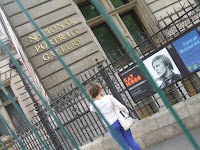 Well, the answer certainly does not lie within the confines of the portraits on display at the NPG. With minimal text accompanying the pictures, I was unsure as to the thinking behind the choices. A panel of 10 "selectors", chaired by Sandi Toksvig, chose a total of 60 portraits. It would have been very interesting if this panel had convened and argued over every single choice, Mercury Music Prize style, but it seems they made their choices in isolation.
Accordingly, each icon seems to have been chosen on the whims and criteria of the individual selector. And some conform to type: Lord Waheed Alli, who made his name in TV, chooses celebrities such as Will Young and Princess Diana. Sir Ian McKellen, a founder of Stonewall, chooses campaigners, such as Angela Mason and Harvey Milk. Writer Alan Hollinghurst chooses writers and composers such as Tchaikovsky and Gerard Manley Hopkins.
Where the exhibit picks up considerably is in the quirky choices. Graham Taylor? Nelson Mandela? Well, yes, if you are Sir Elton John and Billie Jean King, respectively. The first makes some kind of sense, given Elton's connection to Watford Football Club, while BJK speaks of Mandela's dignity in the face of oppression. But, clearly there is no unifying agreement on just what makes a gay icon.
The portraits are also of varying quality. Some are glossy PR shots, such as the one of the Village People (an Alli choice), while the one of Martina Navratilova (a Ben Summerskill choice) is a press shot taken after a Wimbledon triumph.
Chris Smith's choices include no fewer than three subjects who killed themselves, suggesting a link between gayness and tragedy or at least gay icon status and tragedy which is echoed by other selections such as Diana and Bessie Smith (selector Jackie Kay even states that Smith's bisexuality and alcoholism make her a perfect choice as an icon, to which I can only reply: WTF?!).
Surely, in the modern age one could sever this link. But, perhaps his point is that even such high achievers as Alan Turing and Virginia Woolf suffered from social prejudice or mental illness, making them vulnerable beings.
I found myself drawn to two photos, in particular, which hint at the subject's personality and some kind of otherworldly, steely inner quality which would allow for survival and success in the face of such travails. The first was a black and white shot of the social reformer Edward Carpenter (another McKellen choice), pictured in what looks like the entrance to a garden. There is something quite defiant about his jaunty pose, in three-quarters profile, and slightly slouching in his natty plus fours, hat and tie. Even his sandals can't detract from the portrait of a dandified mystic.
The second was of author Patricia Highsmith (a Sarah Waters choice), whose most famous creation, the shape-shifting Tom Ripley, continues to entrance modern readers and filmgoers. In a 1960s publicity shot, Highsmith, whose life spanned the pre-and post-Stonewall eras, gazes moodily at the viewer while holding a book. With her sleeves rolled up, and peering out from her tousled fringe, she oozes sensuality as well as gravitas. Clearly, a woman who means business and my kind of icon.
Accompanying the exhibit is a series of talks and performances, which includes a gig by the Raincoats on the 25th.
![Reblog this post [with Zemanta]](https://lh3.googleusercontent.com/blogger_img_proxy/AEn0k_ta0bSUaQjIqYYMu1B-4gTbiV7WY-e6jcyRbZZbdFp_EdAS64uRlfCH3f6FuK6MrxtC8J6By8o915a-EbEjJlsNq5Hjg7ma_br2sC7AyZUY0qP-uzA9AOTQRe9G6cZVFO4G71eGdpcmqDXWpKxLQu0=s0-d)
through 18 October
In an age in which empty celebrity is exalted above achievement, in which 75% of UK girls aspire to be WAGs (according to this morning's Radio 5), an exhibit called Gay Icons poses some interesting questions: what is an icon? What is a gay icon? Is it someone to aspire to be? Someone who is inspirational? Someone specifically gay who is inspirational to other gay people?
 Well, the answer certainly does not lie within the confines of the portraits on display at the NPG. With minimal text accompanying the pictures, I was unsure as to the thinking behind the choices. A panel of 10 "selectors", chaired by Sandi Toksvig, chose a total of 60 portraits. It would have been very interesting if this panel had convened and argued over every single choice, Mercury Music Prize style, but it seems they made their choices in isolation.
 Accordingly, each icon seems to have been chosen on the whims and criteria of the individual selector. And some conform to type: Lord Waheed Alli, who made his name in TV, chooses celebrities such as Will Young and Princess Diana. Sir Ian McKellen, a founder of Stonewall, chooses campaigners, such as Angela Mason and Harvey Milk. Writer Alan Hollinghurst chooses writers and composers such as Tchaikovsky and Gerard Manley Hopkins.
Where the exhibit picks up considerably is in the quirky choices. Graham Taylor? Nelson Mandela? Well, yes, if you are Sir Elton John and Billie Jean King, respectively. The first makes some kind of sense, given Elton's connection to Watford Football Club, while BJK speaks of Mandela's dignity in the face of oppression. But, clearly there is no unifying agreement on just what makes a gay icon.
The portraits are also of varying quality. Some are glossy PR shots, such as the one of the Village People (an Alli choice), while the one of Martina Navratilova (a Ben Summerskill choice) is a press shot taken after a Wimbledon triumph.
Chris Smith's choices include no fewer than three subjects who killed themselves, suggesting a link between gayness and tragedy or at least gay icon status and tragedy which is echoed by other selections such as Diana and Bessie Smith (selector Jackie Kay even states that Smith's bisexuality and alcoholism make her a perfect choice as an icon, to which I can only reply: WTF?!).
Surely, in the modern age one could sever this link. But, perhaps his point is that even such high achievers as Alan Turing and Virginia Woolf suffered from social prejudice or mental illness, making them vulnerable beings.
I found myself drawn to two photos, in particular, which hint at the subject's personality and some kind of otherworldly, steely inner quality which would allow for survival and success in the face of such travails. The first was a black and white shot of the social reformer Edward Carpenter (another McKellen choice), pictured in what looks like the entrance to a garden. There is something quite defiant about his jaunty pose, in three-quarters profile, and slightly slouching in his natty plus fours, hat and tie. Even his sandals can't detract from the portrait of a dandified mystic.
The second was of author Patricia Highsmith (a Sarah Waters choice), whose most famous creation, the shape-shifting Tom Ripley, continues to entrance modern readers and filmgoers. In a 1960s publicity shot, Highsmith, whose life spanned the pre-and post-Stonewall eras, gazes moodily at the viewer while holding a book. With her sleeves rolled up, and peering out from her tousled fringe, she oozes sensuality as well as gravitas. Clearly, a woman who means business and my kind of icon.
Accompanying the exhibit is a series of talks and performances, which includes a gig by the Raincoats on the 25th.
Sunday, September 06, 2009
Avengers tour
Back in the early '90s when I used to haunt the dank and spooky basement of the Main Library of San Francisco seeking out month-old issues of the NME and Melody Maker, I used to disturb the tranquility of the assistant there, one Penelope Houston, late of first-wave punk band The Avengers.
Most famous for opening for the last ill-fated Sex Pistols show at Winterland in 1978, The Avengers kicked up some pretty fierce agit-punk, such as the anthems "I Believe in Me" and "We Are the One", for which Penelope was the shaven-headed, snotty-voiced singer. Later she became a neo-folkie and released some pretty cool albums, as well as becoming quite successful in Germany.
But, the old punk instincts returned at some point in the late '90s and the band has gone on the road periodically. I never heard the album that came out in '99 but I still have some tattered unofficial vinyl of their original recordings which I found in some second-hand shop years ago, with a grainy Penelope (it's not really a very punk name is it?) on the pink cover.
This month she, Greg Ingraham and some recruits go out on the road with Paul Collins' Beat and Pansy Division for a West Coast tour. There are also some accompanying events, including a photo exhibit (in the Main Library!) and discussions, including one on queer punk. Wish I could be there.
![Reblog this post [with Zemanta]](https://lh3.googleusercontent.com/blogger_img_proxy/AEn0k_vvkZgBcni5gdPe5XnpW9xyLNpdNLqChBYR_Pi2QbqOyiLsB6gRC5i9kbf329NZMmGBbhYlz5Cw6PsEylAkshaJIwkPftd56HgSiiINrLTjilcIvZ9piSrwUNoUcot2q7dKe1dOUZ0rZgAfoU0sWig7=s0-d)
Most famous for opening for the last ill-fated Sex Pistols show at Winterland in 1978, The Avengers kicked up some pretty fierce agit-punk, such as the anthems "I Believe in Me" and "We Are the One", for which Penelope was the shaven-headed, snotty-voiced singer. Later she became a neo-folkie and released some pretty cool albums, as well as becoming quite successful in Germany.
But, the old punk instincts returned at some point in the late '90s and the band has gone on the road periodically. I never heard the album that came out in '99 but I still have some tattered unofficial vinyl of their original recordings which I found in some second-hand shop years ago, with a grainy Penelope (it's not really a very punk name is it?) on the pink cover.
This month she, Greg Ingraham and some recruits go out on the road with Paul Collins' Beat and Pansy Division for a West Coast tour. There are also some accompanying events, including a photo exhibit (in the Main Library!) and discussions, including one on queer punk. Wish I could be there.
Subscribe to:
Posts (Atom)