Saturday, May 26, 2007

Dan Proops

Dan Proops exhibit at Menier Chocolate Factory; photo by Val Phoenix
Sam's Desktop II
Menier Chocolate Factory
London
Through 26 May

A painter who plays with notions of the digital age, Dan Proops' latest exhibit is quite clever. Housed in the Chocolate Factory, an old reclaimed space, the show features paintings of familiar computer images such as the Google logo, as well as works that look back to old masters, such as Caravaggio.

I took a shine to Proops' take on Jasper Johns' "Flag", substituting scroll bars and folders for the stars and stripes. It says something about modern life, surely, that the image is still recognisable, even in dull greys and yellows.

In "Caravaggio Censored", Proops depicts John the Baptist in a Caravaggioesque style but then pixellates the model's genitals, creating a startling juxtaposition of classic chiaroscuro colour and modern digital distortion. Other pictures he has done on this theme pixellate more curious facets, such as the earring in "Girl with a Pearl Earring". The practice asks questions about censorship.

Reblog this post [with Zemanta]

Tuesday, May 22, 2007

This Is England

Still from This is Englanddir Shane Meadows

A curiously unsatisfying film, despite its numerous assets. The story of a boy in an unspecified northern town in the summer of 1983 who falls under the spell of the local skinhead gang and its seriously anti-social leader, the film is apparently partly autobiographical for its writer-director Shane Meadows. Only he will know what is fact and fiction. And perhaps he is keeping his cards close to his chest regarding the absences, as well.

This is a film dripping with absences: the absent father; the absent family and community; the absent moral structure, etc. Into this void comes the lure of nationalism for young Shaun (Thomas Turgoose), who is bullied at school, not fitting into any of the existing style tribes. Falling in with a group of skins, he is adopted as something of a comic mascot, being far younger and more naive than the rest. He gets his first crop, his first Ben Sherman shirt, etc. and he thinks he has arrived. The group is a bit of a joke, really, donning silly costumes to go out "hunting", mindlessly trashing local empty flats. The perceived leader, Woody (Joseph Gilgun), is a nice enough bloke for someone with a cross tattooed on his forehead, and his girlfriend Lol (Vicky McClure) is a pleasant young lady, suitably chastened when Shaun's mum complains about his buzzcut.

However, a more threatening figure appears on the scene, with the arrival of hard nut Combo (Stephen Graham), just out of prison and fired up with nationalist agitprop, although his hard man image is rather undercut by his kiss on the lips for Woody. A pity this foray into homoeroticism wasn't developed. Anyway, Combo divides the group, siphoning off Shaun and a few others, while Woody and Lol withdraw in horror, along with Milky, the only black member.

Combo assumes the role of father figure to young Shaun, the latter having lost his father in the Falklands war, a conflict that Combo derides as pathetic, sending men needlessly to their deaths. This stance is interesting as the war has been widely interpreted as Britain flexing its muscles in the southern hemisphere, keen to hang on to the last vestiges of the empire. Combo's philosophy of nationalism and pride in England is one that is keen to stake out territory and drive out those who don't belong but it remains within England's borders. He takes his "troop" to a speech by a National Front leader and turns against anyone who questions it. Shaun doesn't. He is too much in thrall to being one of the gang. Then again he is 12.

This is one of the dramatic problems of the film. Shaun is largely given free rein because he is so young. Everyone looks out for him: his mother, Woody, Lol, Combo, even Kev, who is thrown out of the troop because he questions Combo's beliefs. Smell, the only female in the group besides Lol to be named, takes a shine to Shaun and becomes his girlfriend, despite several years age difference between them. She, too, looks out for him, in her own way. And I for one, found their romance rather icksome.

But Shaun is highly culpable, being an accessory to a robbery, incidents of intimidation and a savage beating, all with racist motivations. At no time is he called to account for his behaviour. Worse, his mother, who is given little to do in the film, appears utterly clueless as to what he is up to. Those who are old enough to know better don't.

The film promises much, but only partly delivers. All of the female characters appear underwritten. Lol, for instance, has some history with Combo, but what is set up as an intriguing conflict dissipates to nothing. She and Woody simply disappear from the film, as does the mother, until the latter pops up at the end to offer homilies. Milky's character is also hard to figure. What drives him to put himself in danger by going to Combo's house to smoke cannabis, knowing the latter's beliefs? It's a puzzling plot point. And what was with the numbers assigned to each actor in the opening credits? Never figured that out.

The Smiths cover used at the end offers some lyrical clues to the film's gaps: "the life I've had could make a good man turn bad". But that seems a glib copout.

Reblog this post [with Zemanta]

Saturday, May 19, 2007

The Queen

Poster for The Queendir Stephen Frears

In the week that Gordon Brown has been confirmed officially as the next PM after 10 years of unofficially occupying this role, it's instructive to consider the early days of his predecessor, Tony Blair, as depicted in the Oscar-winning The Queen. Of course, Helen Mirren in the title role is the main attraction but Michael Sheen's depiction of Blair catches the eye, with many amusing insights into the Blair Years on view.

Remembering the excitement caused by a Labour government, then a novelty, I was amused to see Sheen's doe-eyed Blair arriving at Buckingham Palace in 1997 for his first meeting with the monarch, looking for all the world like a naughty schoolboy being called to account by the headmistress. Sheen/Blair's every twitch, toothy grin and gormless gesture was met with hilarity by the audience with whom I watched the film, all of us conditioned by 10 years of caricature from the likes of Rory Bremner. It's hard to know where the man ends and the character begins.

Best knowing line:
Aide: Tony, Gordon's on the line.

Blair: Tell him to wait. (And wait and wait...)

Oh, how we laughed.

Anyway, back to The Queen. I wasn't expecting it to be so laugh-out-loud funny. I mean, a film depicting the aftermath of Diana's death with the country experiencing mass hysteria and the royals ensconced in their summer residence of Balmoral castle doesn't seem promising material for comedy.

But Frears and screenwriter Peter Morgan deliver laughs aplenty from the mutual incomprehension of the public, the royals and their advisors and the new Labour government struggling to extract approval ratings from the situation. Blair and Alistair Campbell take on the role of the young modernisers, with Prince Charles (depicted as a handwringing bumbler) trying to cosy up to the new government, while his mother and Prince Philip hold their ground as the traditionalists. In the background is the doddering Queen Mother, clutching her gin and muttering about the absurdities of going against hundreds of years of tradition.

Early scenes of the monarch's brood are more Royle Family than royal family, as they gather around the television watching the coverage of the public's grief and grumbling among themselves. Surely, it cannot have happened this way, with Philip bellowing to be heard and Charles storming off to book a flight to Paris on (shock, horror) a public flight because Mummy wouldn't sanction the royal jet? One almost expects him to burst into tears and clutch at her skirt.

Indeed, it is the queen herself who is reduced to seeking solace from mummy, tentatively knocking at her mother's door and asking her advice on the thorny manner of flying the royal standard at Buckingham Palace, at the behest of the PM who has advised her that her inactions may be damaging the monarchy. It is food for thought to wonder whether the monarchy was really in danger of being toppled over the royal family's lack of visible grief at Diana's demise. Are such monumental decisions really that subject to outpourings of emotion?

Blair's reaction is very telling. At first scornful of the old fossils he is dealing with at the palace, he comes to support the queen, even telling off Campbell in the process. Is it because he hopes for the same kind of staying power as the queen, then on her tenth prime minister? Is it because he sees in her his lost mother, as Cherie (depicted as having a sharp tongue but consistent views, unlike her malleable hubby) suggests? Is it because he wants to be on the winning side, whoever that may be? Hard to tell.

And what of the motif of the handsome 14-point (whatever that means) stag being stalked around the estate by Philip and the young princes while the queen struggles with her emotions, her duty coming first? What does the stag represent that she is so moved by its death? Diana? The monarchy? The queen herself? Again, hard to tell.

A puzzling film then, in some respects, but unexpectedly illuminating, even for those of us who lived through the events on show. I was intrigued to learn Her Majesty and I have something in common, albeit for very different reasons: neither of us can vote.

Reblog this post [with Zemanta]

Friday, May 18, 2007

Xposure Live

Beth Ditto of Gossip at Xposure Live; photo Val PhoenixBarfly
London
16/5/07

When I awoke yesterday, I had a stiff neck and a band of bruising on my left leg, both courtesy of this gig. It wasn't violent, but it was lively.

Playing a small show by their standards, headliners The Gossip were the second coming, judging by the adulation Beth Ditto received with her every sashay, holler and aside. Too bad about the two security guards stationed on the two entrances to the stage, blocking my view (hence the stiff neck) and creating a barrier between her and the crowd. Ironic, really, because the only crowd problems were caused by devotees reaching out to La Ditto when she ventured into the crowd, sending me crashing into the monitors (the bruises). I digress.

The Gossip, of course, are this year's most unlikely top 40 act in the UK, and Mlle Ditto has settled well into her double role as lesbian and anti-fattist spokesperson, even writing an advice column in a daily paper. It's amazing what a few remixes and some timely TV exposure can give you, after years of labouring in obscurity.

I met the band at Ladyfest Scotland in 2001 and spent one enjoyable night sitting up late and talking with Beth into the small hours. By 2003 when they played The Spitz, they had a small but devoted fanbase, while White Stripes and Yeah Yeah Yeahs were playing festivals and big venues. I wondered what the band had to do to reach the same level of success. It appears to have happened by accident but it's well deserved, nonetheless.

Not having seen them in action since 2003, it still came as no surprise when Beth stripped down to bra and girdle, exposing her round frame and flab with delight and defiance. What was new was the numbers of men with cameras surging forward to capture the moment. One called out to her: "You're fit!", leaving the singer bemused. Having disposed of her own garments, she then procured a heart-dotted T from the audience, recognising it as coming from a certain discount chain that starts with P.

Her gifts to the crowd were equally Beth-like: clumps of hair extensions and some sanitary towels secreted in her bra. Sanitary towels: the gift that keeps giving.

Musically, the show wasn't much different from what they were doing four years ago, just with Nathan doing double duty on guitar and bass, and a different drummer, Hannah. Unfortunately, the sound in the venue was crap, badly distorting her powerhouse vocals. Yet it sounded fine on sponsoring station XFM, which played out excerpts later on. Hmmm.

"Jealous Girls" and the opener, a rocked up cover of "Careless Whisper", were standouts, as were the monsta hit "Standing in the Way of Control" and small snippets of "Rebel Girl" and "Mississippi Goddam", perhaps tips to her musical foremothers.

But, the emotional apex for me was the closing song, which she delivered from in front of the monitors. We made eye contact and she started asking me on mic where we had met. "Do I know you?" I nodded and she kissed me on the cheek and we held hands for a few seconds while she sang. It was a moment.

There were no such touch-feely moments from the support acts but they were also impressive. I had heard little of openers Peggy Sue and the Pirates, a quirky sit-down duo who share one guitar and shaker. With a nice line in arch delivery akin to Kate Nash, they had the wittiest lyrics of the night, with one song rhyming "actor" and "wanker".

They were followed by the thunderous Blood Red Shoes, also a duo, comprising guitar and drums. What a wondrous racket they make. Even with earplugs my ears were ringing. It was hard to hear the words but they were spellbinding.

Reblog this post [with Zemanta]

Thursday, May 10, 2007

Pan's Labyrinth

Poster for Pan's Labyrinth; photo by Val Phoenixdir Guillermo del Toro

Having missed this much-talked about film on general release, I was happy to catch it at my local rep arthouse.

And wow. It is an impressive spectacle of sight and sound, its grey, black and brown production design depicting the war-torn rural Spain of the 1940s as well as the fantasy world of a young girl's imagination.

Ofelia (a wide-eyed Ivana Baquero) is the unwilling accomplice of her mother Carmen's ill-advised marriage to the brutal fascist Captain Vidal. Wandering off into her imagination, Ofelia encounters a faun, which sets her three tasks to regain her rightful position of princess of an underground kingdom. Ofelia's struggles with these tasks take her into the grimy confines of a tree root and into a banquet hosted by a grotesque creature.

But no less scary is the martinet Captain Vidal (Sergi Lopez), with his pleasure in instruments of torture and utter lack of regard for Carmen or Ofelia.

Ofelia's only allies are her fairy friends and Vidal's servant Mercedes (Maribel Verdu), who comes more to the fore as the film progresses, risking her life to help the rebels in the woods. She is the film's moral compass, able to see beyond fantasies and cold realities to how she wishes life would be.

Ofelia's fantasy world is an understandable response to her circumstances but her actions have deadly consequences and her obedience to the faun proves as dangerous as her rebellion against Vidal. Both of them are dangerous authority figures.

Perhaps this is del Toro's message: beware false idols.

Reblog this post [with Zemanta]

Friday, May 04, 2007

Scene for New Heritage Trilogy

Brochures for Scene for New Heritage Trilogy; photo by Val PhoenixDavid Maljkovic
Scene for New Heritage Trilogy
Whitechapel Laboratory
London
Until 6 May

DVD, colour, sound 2004-2006

Passing by the Whitechapel Gallery on a sunny Friday, I thought I would pop in and see what's showing. The venerable institution is undergoing refurbishment, having swallowed up the former Whitechapel Library (RIP) next door. Hence, there isn't a Whitechapel Gallery until 2008 or possibly 2009 and it is currently trading as a much-reduced-in-size Whitechapel Laboratory, with a hidden entrance in the alarmingly narrow Angel Alley around the corner from Whitechapel Road.

On show in the auditiorium is Croat artist David Maljkovic's first solo UK exhibition, the DVD installation Scene for New Heritage Trilogy. Knowing nothing of his work, I was intrigued by the three short films linked by subtitles and fades to black. Maljkovic draws on Croatian history to project some fifty years into the future, imagining groups of young people visiting an abandoned building and wondering as to its meaning. In this case, the building is the Petrova Gora Memorial Park, a startling silver undulating building constructed under Tito's regime as a memorial to fallen Partizan soldiers and required viewing for schoolchildren until the fall of communism.

Maljkovic seems to be warning against being too in thrall to history and memory. Given Croatia's fragmented history, it is a poignant warning. The three films are linked by the visits to the site by young people, the first arriving in a silver-foil car, the second a boy with a silver-foil football and the third large groups of people standing around silver-foiled cars. All of them are puzzled by the space, wondering about its meaning and in the last group, waiting for something to happen. The sound design creates an undercurrent of menace to what are quite ordinary visuals. I quite enjoyed it but it does require some knowledge of Croatian history (helpfully provided by the Whitechapel's notes) to be really appreciated.

Friday, April 27, 2007

No Shouts, No Calls

Electrelane
No Shouts, No Calls
Too Pure
UK release 30/4/07

Four albums into their career, Brighton four-piece Electrelane are now investigating the murky world of... pop. Having decamped to Berlin for a spot of summertime songwriting, they returned with a, dare I say, jaunty album focusing on love. Yes, the cinematic organ-grinders have gone all gooey and reflective at the same time and it works. There are still moody noodlings and the odd vocal squall but generally, everything is quite clean-sounding and bright.

The one oddity remains Verity Susman's singing. It seems odd for a vocalist to be developing her sound on a group's fourth album but it sounds as if Susman is still not sure about vocals. And considering they started out as an instrumental outfit, perhaps the group isn't either. Whatever the case, Susman sounds as if she is straining to reach high notes, growling on the low ones and generally wavering all over the shop. All quite quirky but it works for her.


Musically, the album is gorgeous. The drums sound chunky and propulsive on tracks like "The Greater Times, "To the East" and "Five". "Between the Wolf and the Dog" is a bit of a Blondie-esque rave-up and "Cut and Run" features ukulele. Lyrically, our heroines are pondering love, love, love. The aforementioined "Cut and Run" sounds like a lament to a first love. "Saturday" sounds like a playground taunt to a lost love and "To the East" sounds gooey but features frankly indistinct lyrics.

Still growing as a band, Electrelane may be a bit hard to follow through their explorations but this one is a grower.

www.electrelane.com and/or www.myspace.com/electrelane

Thursday, April 26, 2007

Away from Her

Poster for Away from Her; photo by Val Phoenixdir Sarah Polley

Adapted by writer/dir Polley from an Alice Munro short story, this Canadian feature stars Julie Christie as Fiona, a woman succumbing to Alzheimer's while Gordon Pinsent co-stars as her husband Grant who is slowly frozen out of her life as the illness takes over.

Set in a wintry Ontario town, the film contrasts the couple's life together in a remote cottage with the clinical setting of Meadowlake, a care home for Alzheimer's patients. The story is told from Grant's point of view, observing her as she forgets who he is once she is admitted to Meadowlake. With his wolfish features, Pinsent is excellent as the doting husband with a hint of raffishness.

Christie is stunning, the camera often holding in close-up on her startling blue eyes. Her character is multi-faceted, unable to recall the way home when she goes out skiing and yet sharp as a tack in reminding her husband of "the things we don't talk about", namely his flings with nubile co-eds during their 44 years of marriage.

This latter scene, which occurs as he drives her to be admitted to Meadowlake, is absolutely key, because it shows the balance of power in their marriage and it also allows her to dictate the terms under which she is admitted. It is her decision to go. During their farewell, she comforts him. Then, she tells him she wants him to make love to her and then leave. Once 30 days have elapsed, she is allowed visitors but when Grant returns she doesn't seem to recognise him. Instead, she has formed an attachment with another patient, Aubrey, displacing Grant, who suspects she may be punishing him for his failings.

This possibility adds an element of mystery to the story, which is complicated by Grant subsequently seeking out Aubrey's wife (a hawkish Olympia Dukakis) and forming a relationship with her. Is this opportunism on his part? Does he want Aubrey and Fiona to stay together so that he can assuage his guilt at cheating on her? The ending leaves this unclear but the film is gripping, charting an unusual love triangle and then quadrangle.

Reblog this post [with Zemanta]

Friday, April 20, 2007

Portobello Film Festival Launch

Programme for Portobello Film Festival; photo by Val PhoenixCobden Club
London

Oh, dear. I had been looking forward to this evening to launch this year's festival even if it meant a trek to the foreign climes of West London. Nice canal and all but... The Cobden Club is an impressive venue, an old brick working men's club with an unexpectedly posh interior. However... Whose idea was it to site the bar and the screening room in the same space? Within a half hour the noise level from those chatting at the bar was enough to impede and eventually overwhelm the film soundtracks, making it impossible to enjoy the films.

I stayed for half of the four-hour programme of short films and then gave up, so sorry to those I didn't see but take it up with the management.

Standout film of the first two hours was Get Your Tags Out, dir Ben Hilton, which made me laugh out loud. The premise is clever: women treating shopping the way men treat football. So, we had two groups of women staking out their turf and wearing their "colours" and taunting each other in alleyways and shopping malls.

I was intrigued by Viva Liberty! (dir Dishad Husain) which started off brilliantly, as nerdy, bespectacled "Woody Ali" (brilliant) finds himself in the clutches of the US authorities after a misunderstanding on an airplane. As a piece of satire, the premise is excellent, but it didn't sustain the initial burst. This film definitely suffered from the background noise, as it was very wordy. Still, I felt it dragged.

The Wheelhouse (dir Sean Garland) was badly hampered by technical problems with the DVD, so I can't really comment on it.

The Tail (dir Andy Shelley) was another clever film satire on discrimination, setting up a small 1950s-type town in which everyone has a tail. What happens when one man loses his?

Dottie: The Little Girl with the Big Voice (dir Dawn Westlake) took a similar theme of not belonging but in animation, and was also quite funny. For some reason it had subtitles, as well, which proved helpful as it screened during a noisy period.

Thoroughly Modern Mili, by the same director, was less successful, a live action satire on US militarism that went on too long and didn't sustain its premise of a French woman working for the US government. This film was substituted for the opener, Teer, which had technical problems and so didn't screen.

Looking forward to the fest but, strangely, no information was given out about it on the night. Most odd.

Tuesday, April 17, 2007

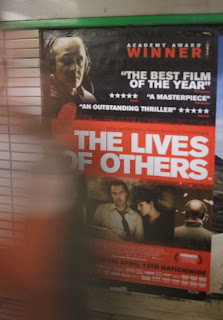
The Lives of Others

Poster for Lives of Others; photo by Val Phoenix
(Das Leben der Anderen)dir Florian Henckel von Donnersmarck

An extraordinarily gripping film looking back to Cold War East Berlin in the '80s and the grip held by the State Security Services, or Stasi, over the population.

In placing a Stasi officer at the centre of the piece, writer/director von Donnersmarck subtly shifts the audience's attitudes toward him, from repulsion to sympathy, as his behaviour changes from blind obedience to flouting his orders.

The officer, Wiesler, a blank-faced man dressed in grey, has been assigned the task of spying on a playwright, Dreyman. The order is politically compromised as a corrupt government official has designs on the playwright's girlfriend, the actress Christa-Maria Sieland. Wiesler starts off his surveillance playing by the book but gradually he comes to sympathise with the couple and starts falsifying his reports. It all climaxes in tragedy but the tension is repeatedly ratcheted up as pressure falls on Wiesler from his superiors and the couple are also compromised.

There are some brilliant moments of black comedy within the film. The repulsive official, Hempf, praises Dreyman with the quote, "Writers are engineers of the soul", before a dissident reminds him the author of the quote is Stalin. He is nonplussed.

The idea of The Good Man becomes a motif, as well, with Dreyman referring to a sonata of the same title and then writing a novel of the same name. The film seems to be asking: who is good? who is evil? can people change? what are the responsibilities of artists?

Thought-provoking, politically charged and very handsomely made.

Reblog this post [with Zemanta]

Festival Roundup

Cheap Gossip Studio at Berlinale; photo by Val Phoenix
Films recently viewed at festivals:

Le Lit Froise
dir Myriam Donasis

French short in which two friends spend an evening drinking and giggling, their bonhomie unexpectedly turning to lust. The bulk of the film concerns the awkward morning after, with frosty silences, awkward chatter and a complete denial of what has happened to change their relationship replacing the earlier drunken exuberance. The unstated emotion is palpable.

Me
dir Chris Spinelli

Very odd experimental short recounting life of lesbian decorator Elsie de Wolfe whose life's work was to "make everything around me beautiful." But rather than a conventional documentary, writer/director Chris Spinelli makes use of strange staged scenarios, voiceovers and addresses to camera to convey de Wolfe's world view. Rather arte and odd.

Berlinale:

Ci Qing (Spider Lilies)
dir Zero Chou

Beautifully shot feature film about tattoos, family relationships and trauma set in Taiwan and featuring a lesbian relationship at its heart. The heroine, who is a flirty teenager with a webcam set up in her bedroom, has lost her parents and wants people to remember her. I was a bit bemused by the lack of depth of this character as she seems to be very superficial. By comparison, the woman she pursues, a tattooist called Takeko, is very grave and more nuanced. She even offers a bit of tattoo philosophy: "Male wants power. Female wants love." This was the Teddy award winner.

Generation K Plus Kurzfilm

Blod Sostre
dir Louise ND Friedberg

Here's an oddity from Denmark: a love triangle of seven-year-old girls, as chubby Sidsel finds a rival for the affections of her neighbour and tries to rid herself of her rival. Poor Sidsel--she just wants to be loved but goes about it the wrong way and finds herself humiliated in a very disturbing sado-masochistic scene featuring birthday cake. All in all, a pretty adult film. Hence it was very startling to see it programmed in the kids section.

Tommy the Kid
dir Stuart Clegg

Aussie boy seeks revenge for the theft of his bike in this very funny faux western.

Hawaiikii
dir Mike Jonathan

Dad makes his daughter a boat for show and tell. Mostly English but no translation of Maori, unfortunately.

More, Strycku, Proc Je Slane?
dir Jan Balej

Delightful Czech animation explaining why the sea is salty and offering a warning against greed and betrayal.

Reblog this post [with Zemanta]

Monday, April 16, 2007

Berlinale Retrospective I: Cheap

Vaginal Davis in the Cheap Gossip Studio at the Berlinale; photo by Val PhoenixAnyone venturing into the atrium of the Filmhaus during the Berlinale would have found him or herself part of a giant art installation. As part of the experimental Forum Expanded strand of the festival, the art collective known as Cheap had turned the space into their Cheap Gossip Studio, adding some light relief to the heavy duty A-R-T going on elsewhere.

Cheap's latest production, with US drag artist Vaginal Davis, is the German fairy tale Max und Moritz, which will premiere in Berlin on 19 April.

The Cheap Gossip Studio, hosted by Davis [see photo above], became the place to be seen for the Berlinale, featuring a circular bar offering Kaffee and Kuchen, various art installations, films and live "Beauty Moments" every evening. Newly arrived in Berlin from Los Angeles and revelling in the atmosphere, Davis offered me a "grand tourina" of the space as well as a helping of his tongue-in-cheek philosophy. The beauty moments, he explained, were key "because we can always look more beautiful. That's very important--beauty. Who cares what you're like on the inside? It's about the outside. That's what counts 'cause that's all anyone sees anyway." A self-proclaimed Sex Repulsive, he made numerous claims for public sex occurring pretty much everywhere in the Studio but I saw no evidence of this.

Though the promised Isabella Rossellini beauty moment failed to appear, others included Miss Pascal offering makeovers and "The Whoracle at Delphi" providing misinformation.

Short films in the space's Rooftop Gallery included Shannon Plumb's lengthy one featuring drag queens attending a fashion show, Marie Losier's of aliens emerging from pots of pasta and Davis's of his friends dancing on a roof. In the Red Gallery Davis had another film featuring him and Cheapie Marc Siegel shrieking over photos taken by the latter's grandfather Sam of various celebs in the '60s and '70s, with Davis suggesting various libelous explanations for their expressions.

Cheap began in 2001 with a co-production performance piece. Its members include Tim Blue; driving force Susanne Sachsse, formerly an actress with the Berliner Ensemble; and Daniel Hendrickson, both of whom are personally involved with Siegel. All very post-modern. They invited Davis and others to collaborate on what the latter describes as a "funky, performancey piece that had these cheap aesthetics, an incorporation of availabism."

Availabism, coined by Kimber Fowler, refers to using what is available to create art and is something Davis has always embraced. "All you need is creativity. I take trash and make sculptures and costumes." The group also shares an admiration for queer experimental filmmaker Jack Smith.

Interestingly, according to Davis, the queer community was a bit suspicious of the group, especially those who knew of Siegel as a gay man. Davis observed, "German sexuality to me is so bizarre. Germans either like to get fisted or cuddling. It's either fisting or cuddling but nothing between that. It's extremes."

He is quite pleased that Sachsse has emerged as a leader within the group. "She puts the projects together. It's so great to have an art collective where it's female-driven... A feminine presence is the main spark to igniting the work and that's really, really rare. Because usually, whether it's straight men or gay men, everything is all about the men. It all becomes about them. The females become kind of tagalong." Sadly, I never got to interview the formidable Frau Sachsse because she was always busy, but I can say she has a crushing handshake.

A lifelong resident of Los Angeles before his recent move to Berlin, Davis sees the German capital emerging as a destination for artists. He has already seen an influx from New York. His own move was prompted by spiralling rents in his hometown. As he explains, "If you don't have cheap rent if you're an artist, you can't do your work 'cause all your time is being spent trying to have a roof over your head. Berlin has got a tradition of [being] bohemian and funkiness." He expects to stay in Berlin for the foreseeable future and travel around Europe to do installations and spread his message of "trying to motivate others to be as comfortable as possible within themselves".

Cheap's version of Max und Moritz transforms it into a girl gang with one boy. Davis, who plays Witwe Bolte, cackles and exclaims that "the boy is their bitch!" Cheap's production of Max und Moritz premieres in Berlin on April 19th at Theater an der Parkaue. It will also play in Hamburg and Graz.

Reblog this post [with Zemanta]

Saturday, April 14, 2007

The Unilever Series: Karsten Höller

Karsten Höller installation at the Tate Modern; Karsten HöllerTate Modern
London

A bit late with this one as it closes on 15 April but it's well worth a visit if you get the chance and can stomach the queues.

A friend and I visited on Friday evening, late night at the Tate, and so appropriate for those who work weekdays or are seeking an alternative to the usual drink-and-puke Friday evening. I arrived first to get a spot in the queue and reached the front well before he arrived and so had to start over again. Once we were both on-site (it's not possible to pick up tickets for anyone not in the queue--very annoying), we were each able to get a ticket for slides on Level 3 and Level 5. As the numbers suggest, these are progressively higher up, daunting for those with a fear of heights, which both of us have.

With plenty of time on our hands (even showing up at 18:00 may not get you a booking before 20:00. Ours were for 20:30 and 21:00/21:30, respectively), we took advantage of the lovely weather to sit by the Thames drinking and chatting and watching people stroll along the shore line at low tide until it got too cold and we returned to the warmth of the Tate.

Availing ourselves of the permanent exhibitions we moved up level by level and by Level 5 we could hear the shrieks of people using the slides, adding an aura of anticipation/anxiety to the proceedings. With hours to wait, we had built up quite a lot of nerves by the time we visited the Level 3 slide. Looking down into the vast Turbine Hall below, it seemed quite a drop.

Although the slides have several turns, it is still a daunting prospect. Once you have collected your slider (a long piece of linen like an apron to sit on and to trap your feet), you position yourself at the entrance to the tube and wait to be given the signal, much like a luger or downhill skier. I was sweaty with nerves by this time and once I let go I was quickly sucked down the tube, jolting the whole way. I emerged some, I guess, 30 seconds later, quite shaken up and with legs like jelly.

Now imagine the same experience but two floors up on level 5. By now my mate and I had visited the cafe for some liquid courage. As a teetotaler, mine was a hot chocolate but nevertheless, we were both still goading each other. He had said he almost bit his tongue on the first go-round. "I bet it would look really cool if I got a picture of you with your tongue bleeding," I offered helpfully. "I hear people who don't wear elbow protectors have had their limbs severed," he commented, as I waited to go on, sans elbow protectors.

Down I went, and the experience was multiplied, but I was rather preoccupied with trying to get my camera to work so that I could record the movement. Sadly, the on button just wouldn't work and so I emerged, almost sliding off the rails, and trying to get my shaky legs to work again at the other side. I just got the camera on as my friend emerged, tongue intact. We had done it and neither of us had screamed.

In truth, the slides are quite enjoyable to watch, as well. The structures fit well within the Turbine Hall, making use of its impressive height and their gleaming silver and glass spirals echo the former industrial function of the building as a power house. While I still hold a fondness for Olafur Eliasson's Weather Project (2004), I would say this is the best interactive use of the Hall since the Tate Modern opened.

And as for the meaning? Well, Höller is quoted as saying he wants to explore both the spectacle and inner spectacle of sliding, of watching people perform this ritual and performing it yourself. In that, he has succeeded. And, as the queues attest, people of all ages seem drawn to this idea.

Reblog this post [with Zemanta]

Wednesday, April 04, 2007

LLGFF IV

Filmmakers Ash Christian and Lisa Gornick at the London Lesbian and Gay Film Festival; photo by Val PhoenixThe Authorial Voice

Ticktock Lullaby
Fat Girls

Two films by writer/director/star triple threats premiered at the festival with Lisa Gornick's feature and the debut by 21-year-old Ash Christian. By chance, the two filmmakers ran into each other outside the screening of the latter [see photo] and chatted re: the perils of directing oneself. Both confessed to being control freaks. There is a touch of the Woody Allen about this approach, with a strong authorial voice appearing in both which can polarise opinion. One person's quirkiness is another's self-indulgence.

My responses to these two were certainly polarised. I warmed to Fat Girls' outsider triumphs over adversity portrayal of small-town America, while Tick Tock Lullaby left me cold as I waited for something to happen. Its tale of a self-obsessed lesbian couple trying to have a baby exhausted my patience when after 20 minutes the couple (played by Gornick and Raquel Cassidy) were still agonising over whether to go ahead. Some would be charmed by Gornick's interior monologues and recurring cartoons to depict her inner turmoil. I was annoyed.

Fat Girls featured a motley crew of geeky fat gay boy, fat straight girl and Cuban refugee all stranded in a dead-end Texas town full of rednecks and closet cases. The director takes the lead role of Rodney, called Chub by his devout Christian mother, who lusts after the cool English kid at school and gives secret blow jobs to the football captain in the closet. Much of it is played for laughs and the experience of being the uncool kid at school probably resonates with many people. It did for me. The film, shot on mini DV, is certainly rough around the edges, with unbeautiful cinematography and a few lapses in pace. However, Christian certainly has made his mark and the characters will apparently be reappearing in a new series for MTV.

Good Doc/Bad Doc

The Railroad All-Stars
Mirror Mirror

More sublime to ridiculousness in two feature-length documentaries. Railroad All-Stars is an astounding piece of film-making from Spanish director Chema Rodriguez, about a football team formed by prostitutes in Guatemala City to highlight the discrimination facing them. Rodriguez has a sympathetic eye and her camera always seems to be on hand when something eventful happens, which it does often, as they are kicked out of their league, argue among themselves and personal relationships deteriorate among the team. So many big personalities are on hand that it is difficult to follow sometimes and my only complaint was that the names were only shown onscreen once rather than repeated during the 90 minutes.

Among the teammates are Vilma and Lupe, who break up and reunite at least once during the story. Team captain Valeria visits her gang member boyfriend in jail. Mercy has left behind her children in El Salvador and Carol is being abused by her male partner. The team coach is the flamingly gay Kimberly, who has his own story, too. Rodriguez has a bounty of material and yet constructs a clear narrative as the team goes on a national tour and then heads for a match in El Salvador. I found myself rooting for them in their matches and willing them to succeed. Sadly, there is no Hollywood ending for these women as a coda informs us of what happened once the cameras stopped rolling. Life for sex workers is bleak and they are no exceptions.

Mirror Mirror, by contrast, takes a fascinating subject, the poly-gendered Wotever Club in London, and manages to make it extremely dull by using an interactive approach in which the subjects, including the club promoter Ingo and some of the performers, were invited to give their feedback on Zemirah Moffat's film as it was being made. This results in some of the most self-conscious, over analysed and processed filmmaking I've seen. All the life is squeezed out of this film and it drags badly. Patrick Stewart lookalike Lazlo Pearlman offers some unintentional comedy when he says he finds the project highly intellectual. Moffat says at one point in her voiceover that she finds that the characters are becoming aspects of her desire. But there is precious little desire on show.

Also viewed:

Itty Bitty Titty Committee

Finally, a Riot Grrrl film, if only 15 years late.

With Bikini Kill, Heavens to Betsy, Le Tigre and Sleater Kinney on the soundtrack and a plotline featuring an underground radical feminist group, it's not your usual fare. Baby dyke Anna hooks up with the feminist activist group CiA for actions, while falling for the alluring leader Sadie at the same time. But, there's a problem... Plenty of dyke drama ensues.

The cameos by famous dykes like Guin Turner, Jenny Shimizu and Daniela Sea are a bit inside joke, but it is a solid and enjoyable piece of work cleverly juxtaposing politics and comedy. And certainly, the arguments, the political bickering and the passion ring true. Almost like Dykes to Watch Out For come to life.

As with The Perfect Ones (see LLGFF II), the feel is very early nineties. Really, just the group's website and mention of the Iraq war place it in the late noughties, rather than the early nineties. I wonder if the screenwriters had the idea years ago and just gave it a slight tweak to bring it up to date.

Reblog this post [with Zemanta]

Monday, April 02, 2007

Tiny, Funny, Big and Sad

Detail from Tiny, Funny, Big and Sad; photo by Val PhoenixJennifer and Kevin McCoy
Tiny, Funny, Big and Sad
BFI Southbank
Until 28 May 2007

This installation in the new foyer of the NFT is delightful and clever. The four sets in the Gallery, the Traffic series, use miniatures to depict important moments from the couple's lives incorporating moments from cinema. But by using tiny video cameras, live footage of the moving miniatures is screened on the gallery wall as well as within the sets. Must be seen to be believed.

LLGFF III

Exterior of Southbank Centre; photo by Val PhoenixRadical Desire
31/3/07
NFT

This was the big femme shindig, with a programme of short films, a live performances and a lively Q&A/argument at the end. Something for everyone, then.

The night kicked off 30 minutes late, thanks to the previous programme over-running. Bird Club on Film performed a rather scrappy and under-rehearsed skit, culminating in some jokey porn accompanied by them singing "Birds on Film" to the tune of "Girls on Film". Not really sure what this added to the evening.

The films, as picked by the unnamed curator, spanned the sublime to the ridiculous. Dara Birnbaum's fabulous re-rendering of Wonder Woman, Technology/Tranformation: Wonder Woman, from 1978, was a crowd pleaser, with Lynda Carter's every appearance loudly applauded.

Dames was a witty lesbian reworking of film noir, by Maureen Devanik Butterfield, in which the two "dames" decided they really didn't need their gangster boyfriends.

Love Struck, by Susan Ali, was laugh-out-loud funny, as Cupid's accuracy let him down, requiring one of his targets to take matters into her own hands.

Debris, by Justin Kelly, left me utterly bemused. No idea what was going on there.

Meeting of Two Queens, from Cecilia Barriga, was another classic, a 1991 collage of clips of the marvellous Marlene and Greta, reclaimed to create a new meaning.

Two newies finished off the programme. I Want to Be a Secretary started off intriguingly enough with a naive secretary starting off her first week at work, keen to make a good impression. However, the story-telling techniques: archive footage and voiceover, really did not sustain the 12 minutes of the story. I found myself a bit restless before it ended on a very odd note, with Dusty Springfield singing over a montage of secretaries.

The most popular film was the world premiere Fem, by Inge Blackman. Several of the women in it were at the screening and cheered loudly during and after the screening. This film also generated the lively discussion at the end, as femmes applauded its celebration of them. The film was a butch appreciation of femmes and set them up in glossy settings as fantasy objects/subjects.

Not finding myself anywhere on the femme-butch spectrum, I remained immune to the thrill that much of the audience seemed to find in this. I don't share the view that femmes don't see themselves depicted onscreen or receive appreciation in the mainstream or the lesbian world. The film programme itself showed that and those films span 30 years. I was also uneasy at the curator repeatedly declaring how wonderful it was to see "beautiful women" onscreen as if femmedom was the only way a woman could appear beautiful. Nobody questioned this statement.

However, the post-film discussion quickly degenerated into a competition as to who is more oppressed, a bit of a pointless exercise. Blackman spoke of wanting to celebrate women who work in the community and of lesbians giving ourselves permission to look at women. Good points well made.

Queer in Your Ear?
30/3/07
NFT

More looking in this music video programme of queer and queer-friendly artists ranging from up and coming indie types Promo Funk and Grizzly Bear to the pop fluff of Kylie and Scissor Sisters. It's a pity the gender ration was so skewed with only two or three queer women in 16 videos. Nonetheless, my favourites included "Pass This On" by The Knife as much for the song as for the video featuring Sweden's leading drag queen. Bjork's "All Is Full of Love" was included presumably because it features two female-featured robots getting jiggy. However, since both of them are Bjork, this is more a case of self love rather than same-sex love, surely.

Gossip's video for "Standing in the Way of Control" isn't up to much, is it? Still, it's great to see Beth strutting her stuff. The standout, however, by a long way was Peaches' "Downtown", which managed to encompass gender play, S/M, glamourous settings and an absolutely filthy song. She also dons butch and femme drag to have sex with herself. But didn't Annie Lennox do this about 20 years ago?

Reblog this post [with Zemanta]

Saturday, March 31, 2007

LLGFF II

Troubled Teens

Sonja
Love Sick

Kids, eh? Who'd have 'em, with their sulky silences, lack of self control and untamed passions? Two features at LLGFF provide ample evidence of the suffocating grip of infatuation and the lack of a happy-ever-after guarantee. Both from central Europe and both featuring girls in education, Sonja and Love Sick illustrate love is cruel.

Sonja, a Berlin teenager stuck in a tower block with her suspicious mother, is pouty, spotty and infatuated with her best friend, Julia, when not flirting with boys, returns Sonja's intense gazes and affectionate touches. Sadly, they are not quite on the same page, no matter what Sonja's suspicious mother thinks. The film beautifully depicts the intensely close relationships girls can form, with words unnecessary. But, it also shows how these feelings can remain unrequited and heartbreaking.

The Rumanian feature Love Sick is a quite startling piece of work, with a budding lesbian love story set alongside a grimly dysfunctional family drama. Alex moves into her new rented room for her second year at university, reuniting her with her girlfriend Cristina. However, Cristina has some serious co-dependency issues with her brother Sandu, wrecking everyone's hopes of a happy ending. The scene when Cristina and Sandu confront each other across the family dining table, their parents and Alex looking on, is a triumph of black comedy. The film's structure is a bit confusing, with the occasional flashback and voiceover interrupting the story. Curiously, although Alex appears to be the central character, the voiceover is actually by Cristina, making the point of view a bit tenuous. The last five minutes is also a bit of a letdown, descending into melodrama as the two women have their showdown. Still, the film lingers in the memory.

Also viewed:
Krudas

A documentary from Cuba about a lesbian feminist rap group. And you don't see that every day. While somewhat lacking in style and running on a bit, the two central figures, a lesbian couple, are so charismatic, that you really want to cheer them on. The music's good, too.

The Perfect Ones

Echoing Desperately Seeking Susan in plot, this short from the USA takes a troubled housewife (played by co-director Nao Bustamante) out of her comfortable environs and plants her on the mean streets of the city. Stiletto stuck to her hair, she stumbles into a punk club and emerges as a whip-crackin' mama. Great fun, even if it does feel curiously stuck in the '80s.

Reblog this post [with Zemanta]

Friday, March 30, 2007

Clash of the Poison Dwarves

Infamous
Capote

In her book, A Killer Life, producer Christine Vachon expresses astonishment at learning of "the other Capote film", i.e., Capote, and questioning how it could possibly be as good as her project in development, Infamous. Sadly for Vachon and co., Capote came out first, snaffled the reviews and awards and left precious little for Infamous, following on its heels, to recoup.

A recent viewing of Infamous, with Toby Jones in the Capote role, bears comparison to the earlier Capote, which won Philip Seymour Hoffman a Best Actor Oscar. Both deal with a turbulent period in the author's life as he researched and wrote In Cold Blood, his breakthrough work, based on the murders of a family in Kansas. Both films chart his relationship with one of the accused killers, Perry Smith, as he works on the book in Kansas, while his friend Nelle Harper Lee, author of To Kill a Mockingbird, acts as moral compass. Sulking in the background, left behind in New York working on his own book, is Capote's boyfriend, Jack Dunphy.

Infamous director Doug McGrath has stated that his film shows more of Capote's charm, along with his fierce ambition for his book. Curiously, I found this lacking in the film, feeling he came across just as manipulative and selfish as in Capote. No doubt he could tell a good anecdote, many of which dot Infamous, as he dazzles his society "swans", as well as the small-town locals in Kansas. But all his anecdotes come back to one thing: himself and how clever he is. Sandra Bullock as Lee spends a lot of time looking at her shoes or smiling indulgently at Capote's hubris. Catherine Keener in Capote was a bit sharper and more knowing in her interpretation.

But, for me, Lee comes through as the most intriguing character in both tellings of the story. Along as research assistant for Capote's trip to Holcomb, Kansas, she provides his "passport to normality", as Capote puts it, making a connection with a schoolgirl to get information. In Infamous, she tells Capote to try to "come in under the radar" to reach the townfolk. It is Lee who first hears the alarm bells ringing as Capote becomes obsessive about his book and uses his growing intimacy with Smith to further his ends, to the extent that he tells her that it would be better for the book if the killers are executed.

Whereas Capote traced an ambiguous relationship between Capote and Smith, in which Capote was clearly infatuated, Infamous is much more explicit in its depiction of a mutual attraction and consummation. In Infamous, Daniel Craig is a much hunkier proposition as Smith than Clifton Collins Jnr. and he broods and storms in equal measure. The physicality he brings is brought to the fore, with Smith roughing up Capote and even threatening to rape him.

Once they do reach an understanding, Infamous has the two pursuing something of a courtship, with Smith sending "friend Truman" intimate letters and even music. The scene in which the two killers go to their executions is climactic in both films, leaving onlookers on-screen and off deeply uncomfortable.

Both films recount the irony that whereas In Cold Blood made Capote as a celebrated author, it ruined him as a person, leaving him unable to finish another full-length work and turning him into a parody of himself, a ubiquitous party guest with the next novel forever in progress. In Infamous, Lee comments ruefully that writers die a little with each new work and the next one is so hard. Their trip to Kansas seems to have robbed both her and Capote of some creative vitality, with neither able to produce "what's next".

Reblog this post [with Zemanta]

Tuesday, March 27, 2007

NPA shorts finale

Filmmakers at NPA Shorts Awards; photo by Val PhoenixNPA SHORTS
22/3/07
Genesis Mile End
London

After a year-long process of screenings and eliminations, the final eight contenders had their day with a screening and audience award, as well as an industry award.

I detected a theme of moral quandaries among several of the shorts. The one I found most striking was Breaker, directed by Nick Scott and produced by Fiona Brownlie. This film worked well as a story as well as technically. The protagonist, a failing artist, alights upon a can't-miss concept to retain his patron's support and break through to the mainstream: photographing broken windows. But how can he ensure a steady supply of broken windows? By breaking them himself. As a wry comment on artistic licence and morality it works well, but the characters were also intriguing, the moral compass being a neighbour of the artists with whom he trades art: her origami for his photos. Plus, it was shot in black and white, giving it a moody, classic feel.

Sadly, Breaker won neither audience nor jury prize. The latter went to Jez Benstock's Holocaust Tourist, a documentary asking whether such a thing is morally justified. Strangely, Benstock's was the only film with no representation at the event.

The audience award went to Rudolf Buitendach's Rearview, which I found a bit creepy. It was shot in one take and cost £400, which seemed to intrigue many. But I found it a bit gimmicky and the twist at the end did not endear me to it at all.

Family Portrait was quite striking, composed of home movies and pictures over a woman's call to 999 as her husband breaks into the house. I remember the news story on which it was based and it creates real menace.

The other films didn't quite work for me. Wooden Soul featured a girl killing her fish. String seemed gimmicky and pointless. One Hundredth of a Second set up another moral quandary with a photojournalist on location in a war zone faced with a girl in danger. But then it dropped the ball with a London-based setting. This film felt like the opening scenes of a longer film rather than a piece of itself. Indeed, the filmmakers hope to shoot a feature. A Lump in the Road had an intriguing set-up as a daughter tried to jolly her terminally ill mum with a fantasy trip but it didn't really deliver either.

Reblog this post [with Zemanta]

First Runs

The Illusionist
Freedom Writers

In contrast to the arty, independent fare on offer at the festivals, here are two features doing the rounds. The Illusionist flatters to deceive, promising some sleight of hand and delivering a frankly ludicrous plot twist. Still, it is lovely to look at, bathed in rich earth tones and 19th century Austrian period detail. Edward Norton is a compelling anti-hero, Rufus Sewell a vein-popping villain and Jessica Biel underwritten as the pivot of the love triangle.

Freedom Writers is typical US do-gooder inner-city drama with Hilary Swank the earnest white middle class young teacher trying to make a difference to her racially polarized class in early ‘90s LA. Footage of the 1992 Rodney King riots sets the tone and the new teacher gives the kids journals to detail their extremely violent lives. As these were published in 1998, I was a bit confused about timing.

I perked up when Anne Frank entered the story. No, really. The young diarist becomes an unlikely role model for the troubled war-torn teens, one of them exclaiming, “Anne Frank--she understands my situation.” Well, no, seeing as she died in 1945, it’s unlikely she understands you at all but rather you understand her, my friend.

Nonetheless, the film, despite its laughable emotional manipulation (you know something really dramatic is happening when the music swells or one of the tough gangsta boys sprouts a tear running down his cheek) is rather gripping and even somewhat uplifting. Plus, it’s rare to see prominent female roles in inner-city dramas, with Swank and a couple of the students carrying the story.

Reblog this post [with Zemanta]